Chapter 3 Measures Of Dispersion Statistics 11th Class Punjab MCQ Tests
11th Class Statistics Chapter 3 MCQ Tests
Chapter 3 of 11th Class Statistics has 35 questions. If you take an online MCQ test, the system will randomly choose the questions. If you want to take the quiz by chapter then click the start test button.
Total Questions: 35
Total Marks: 35
Time: 35 Mins
Total Questions: 35
Total Marks: 35
Time: 35 Mins
35Min : 00 Sec Remaining
Question # 1
If m 4 = 50, m 1 = 0, m 2 = 5.2, find b 2.
Question # 2
The standard deviation is independent of:
Question # 3
If the first 25 percent observations of a series are 20 or less and last 25 percent observations of a series are 50 or more, the co-efficient of Q.D is:
Question # 4
The value of coefficient of kurtosis β 2 can be:
Question # 5
The mean and standard deviation of a set of values are 25 and 5, respectively. If a constant value 5 is added to each value then find the coefficient of variation of the new set of values.
Question # 6
If quartile deviation of certain items is 20 and mean is 50 then what is the co-efficient of Q.D.
Question # 7
If Var(X) = 16, then find variance of 2X + 4.
Question # 8
Average wages of workers of a factory are Rs. 550 per month and the C.V = 20%. Find the standard deviation of wages.
Question # 9
Sum of all squared deviations is divided by total number of observations to calculate _____.
Question # 10
If quartile range is 24 then quartile deviation is:
Question # 11
By multiplying each of the numbers 3, 4, 2, 1, 5 by 2 and adding 5, find new standard deviation.
Question # 12
If the moment co-efficient of kurtosis b2 = 3, then the distribution is:
Question # 13
If the value of β 2 for a distribution is 3, the frequency curve is said to be:
Question # 14
For a moderately skewed distribution, the empirical relation between mean (M), median ( Md ) and mode ( Mo ) is given by:
Question # 15
In case of negatively skewed distribution, the relation between mean, median and mode is:
Question # 16
For a leptokurtic distribution, the relation between second and fourth central moment is:
Question # 17
The degree of peakedness or flatness of a unimodal distribution is termed as:
Question # 18
The first and second moment about arbitrary constant are -2 and 13 respectively. Find the second moment about mean.
Question # 19
The coefficient of skewness obtained by three times of difference between mean and median is divided by standard deviation, this method is proposed by:
Question # 20
Median of a moderately skewed distribution is 8, third quartile is 12, first quartile is 8 and inter-quartile range is 4 then what is the relative co-efficient of skewness?
Question # 21
If the third moment about the mean is zero ( m3 = 0), then the distribution is said to be:
Question # 22
Inter quartile range and coefficients of range are two categories of:
Question # 23
If values of skewness and arithmetic mean is given as 4 and 17 respectively then what is the mode of given values?
Question # 24
Find the third mean moment of the following values: 8, 10, 15, 22, 26, 30, 35, 40, 48.
Question # 25
If Y = a X ± b , where a and b are any two constants and a ≠ 0 , then Var (Y) is equal to:
Question # 26
If total sum of square is 20 and sample variance is 5 then total number of observations are:
Question # 27
Coefficient of quartile deviation is a:
Question # 28
The height (in feet) of 8 waterfalls in different parts of the world are as follows: 1904, 1215, 2307, 2000, 1612, 2800, 2425, 1170. Find the interquartile range.
Question # 29
If Y = a X ± b , where a and b are any two constants and a ≠ 0, then the quartile deviation of Y values is equal to:
Question # 30
The unit less measure of dispersion is _______.
Question # 31
The scores obtained by five students on a set of examination papers were 70, 50, 60, 70, 50. These scores are changed by increasing all scores by 10%. What is the difference between new and original S.D.
Question # 32
Average deviation measures and distance measures are classified as measures of dispersion on basis of:
Question # 33
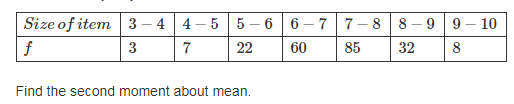
Find the second moment about mean.
Question # 34
The following distribution gives the number of houses and the number of persons per house. Find coefficient of range.

Question # 35
If Y = a X ± b , where a and b are any two numbers and a ≠ 0 , then the range of Y values will be:
Total Questions
1234567891011121314151617181920212223242526272829303132333435
Question # 1
If m 4 = 50, m 1 = 0, m 2 = 5.2, find b 2.
Question # 2
The standard deviation is independent of:
Question # 3
If the first 25 percent observations of a series are 20 or less and last 25 percent observations of a series are 50 or more, the co-efficient of Q.D is:
Question # 4
The value of coefficient of kurtosis β 2 can be:
Question # 5
The mean and standard deviation of a set of values are 25 and 5, respectively. If a constant value 5 is added to each value then find the coefficient of variation of the new set of values.
Question # 6
If quartile deviation of certain items is 20 and mean is 50 then what is the co-efficient of Q.D.
Question # 7
If Var(X) = 16, then find variance of 2X + 4.
Question # 8
Average wages of workers of a factory are Rs. 550 per month and the C.V = 20%. Find the standard deviation of wages.
Question # 9
Sum of all squared deviations is divided by total number of observations to calculate _____.
Question # 10
If quartile range is 24 then quartile deviation is:
Question # 11
By multiplying each of the numbers 3, 4, 2, 1, 5 by 2 and adding 5, find new standard deviation.
Question # 12
If the moment co-efficient of kurtosis b2 = 3, then the distribution is:
Question # 13
If the value of β 2 for a distribution is 3, the frequency curve is said to be:
Question # 14
For a moderately skewed distribution, the empirical relation between mean (M), median ( Md ) and mode ( Mo ) is given by:
Question # 15
In case of negatively skewed distribution, the relation between mean, median and mode is:
Question # 16
For a leptokurtic distribution, the relation between second and fourth central moment is:
Question # 17
The degree of peakedness or flatness of a unimodal distribution is termed as:
Question # 18
The first and second moment about arbitrary constant are -2 and 13 respectively. Find the second moment about mean.
Question # 19
The coefficient of skewness obtained by three times of difference between mean and median is divided by standard deviation, this method is proposed by:
Question # 20
Median of a moderately skewed distribution is 8, third quartile is 12, first quartile is 8 and inter-quartile range is 4 then what is the relative co-efficient of skewness?
Question # 21
If the third moment about the mean is zero ( m3 = 0), then the distribution is said to be:
Question # 22
Inter quartile range and coefficients of range are two categories of:
Question # 23
If values of skewness and arithmetic mean is given as 4 and 17 respectively then what is the mode of given values?
Question # 24
Find the third mean moment of the following values: 8, 10, 15, 22, 26, 30, 35, 40, 48.
Question # 25
If Y = a X ± b , where a and b are any two constants and a ≠ 0 , then Var (Y) is equal to:
Question # 26
If total sum of square is 20 and sample variance is 5 then total number of observations are:
Question # 27
Coefficient of quartile deviation is a:
Question # 28
The height (in feet) of 8 waterfalls in different parts of the world are as follows: 1904, 1215, 2307, 2000, 1612, 2800, 2425, 1170. Find the interquartile range.
Question # 29
If Y = a X ± b , where a and b are any two constants and a ≠ 0, then the quartile deviation of Y values is equal to:
Question # 30
The unit less measure of dispersion is _______.
Question # 31
The scores obtained by five students on a set of examination papers were 70, 50, 60, 70, 50. These scores are changed by increasing all scores by 10%. What is the difference between new and original S.D.
Question # 32
Average deviation measures and distance measures are classified as measures of dispersion on basis of:
Question # 33
Find the second moment about mean.
Question # 34
The following distribution gives the number of houses and the number of persons per house. Find coefficient of range.
Question # 35
If Y = a X ± b , where a and b are any two numbers and a ≠ 0 , then the range of Y values will be:
Total Questions
1234567891011121314151617181920212223242526272829303132333435
Statistics MCQ Test by Topics
- +3.1 Dispersion
- +3.2 Range
- +3.3 Mean Deviation
- +3.4 Quartile Deviation
- +3.5 Variance and Standard Deviation
- +3.6 Coefficient of Dispersion
- +3.7 Moments
- +3.8 Skewed vs Unskewed Curves
- +3.9 Kurtosis
Statistics
- Representation and Exploration of Data
- Measure of Central Tendency or Averages
- Measures of Dispersion
- Index Numbers
- Regression and Correlation Analysis
- Analysis of Time Series
- Set Theory
- Introduction to Probability
- Random Variables and Distributions
- Binomial and Hypergeometric Distributions
- The Normal Distribution
- Sampling and Sampling Distributions
- Statistical Inference:Estimation
- Statistical Inference:Hypothesis Testing
- Association of Attributes










11th Class Online Classes 2026
Updated on: 14-10-2026
11th Class Online Preparation
11th Class 2026 Online
11th Class 2026
Add a Comment
Comments will be shown after admin approval.
Spam comments will not be approved at all.
Matric Result 2026 Punjab
10th Class Result 2026 Punjab
9th Class Result 2026 Punjab Boards
10th Class Result Gazette 2026 Punjab
Punjab Past Papers Matric 9th 10th
Primary Results 5th & 8th Class
BISE Results Intermediate & Matric
BISE Punjab Boards
Sindh Educational Boards
KPK Examination Boards
Technical Boards
Public Service Commission
University Results Gruaduation, Masters Classes
Subscribe by Email
Subscribe by Email
Subscribe to Rss Feed


Position Holders Matric 2026
Position Holders 9th Class 2026
Position Holders Inter 2026
Position Holders 11th Class 2026
Punjab 11th Class Statistics