Chapter 8 Chemical Equilibrium Chemistry 11th Class Punjab MCQ Tests
11th Class Chemistry Chapter 8 MCQ Tests
Chapter 8 of 11th Class Chemistry has 34 questions. If you take an online MCQ test, the system will randomly choose the questions. If you want to take the quiz by chapter then click the start test button.
Total Questions: 34
Total Marks: 34
Time: 35 Mins
Total Questions: 34
Total Marks: 34
Time: 35 Mins
35Min : 00 Sec Remaining
Question # 1
What is the percent ionization of 1.2 M HF solution? K a = 7.1 × 10 − 4
Question # 2
Methanoic acid reacts with water as in the following reversible reaction:
H C O O H + H 2 O ⇌ C O O H − + H 3 O +
Which of the following pairs comprises of acids, according to the Bronsted-Lowry definition?
Question # 3
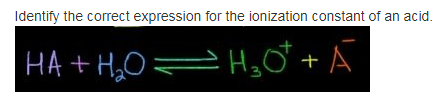
Simplify
Question # 4
In Haber's process, for every 1 mole of nitrogen, how many moles of hydrogen are used, according to balanced equation?
Question # 5
A strong acid has a large Ka value. True or false?
Question # 6
Which of the following is TRUE for a weak acid?
Question # 7
A substance that donates a pair of electrons to form coordinate covalent bond is called _____.
Question # 8
KW is dependant on temperature. It _____ as temperature is decreased.
Question # 9
Identify the dissociation product of the following reaction? H + + H 2 O → ?
Question # 10
Chemical equilibrium state is _____.
Question # 11
Which change will shift the position of equilibrium to the right in this reaction? N 2 ( g ) + 3 H 2 ( g ) ⇌ 2 N H 3 ( g ) Δ H = − 92 k J
Question # 12
Which change(s) will increase the amount of S O 3 ( g ) at equilibrium? 2 S O 2 ( g ) + O 2 ( g ) ⇌ 2 S O 3 ( g ) Δ H = − 197 k J
Question # 13
what is the pH of pure water at this temperature?

Question # 14
In case of which of the following conditions, an equilibrium CANNOT be attained?
Question # 15
Which one of the following is equal to the pKa of a weak acid?
Question # 16
A mixture of CH3COOH and CH3COONa behaves as _____.
Question # 17
A mixture of N H 4 C l and N H 4 O H shows no change in pH upon addition of small amount of HCl. This is because it is _____.
Question # 18
The ionic product of water will increase if _____.
Question # 19
Which of the following properties is NOT necessarily required to be constant to attain a chemical equilibrium?
Question # 20
Choose the correct unit for equilibrium constant for dissociation of P C l 5 ?
Question # 21
We eat a variety of foods still pH of our blood does not change every time. The reason is _____.
Question # 22
Position of equilibrium will be towards left side if the value of Ka is _____.
Question # 23
For the reaction N 2 ( g ) + 3 H 2 ( g ) ⇌ 2 N H 3 ( g ) Δ H = − 92 k J What conditions will produce the highest percentage of ammonia at equilibrium?
Question # 24
H C O − 3 ( a q ) + H F ( a q ) ⇌ H 2 C O 3 ( a q ) + F − ( a q )
Which of the following is an acid-base pair in the reaction?
Question # 25
The catalyst used in Haber's process is _____.
Question # 26
A species which is able to accept a proton is called _____.
Question # 27
Role of NH4Cl in qualitative analysis of third group cations is _____.
Question # 28
In reverse reaction, what does SO3 decompose into?
Question # 29
What is the concentration of O H in a 0.20 M solution of ammonia?
Question # 30
Which of the following is FALSE about a strong base?
Question # 31
Which of the following statements is NOT true?
Question # 32
Three acids found in food are lactic acid (in milk products), oxalic acid (in rhubarb), and malic acid (in apples). The p K a values for lactic acid (LA), oxalic acid (OA) and malic acid (MA) are 3.88, 1.23, and 3.40 respectively. Which of these are in the order of decreasing acid strength?
Question # 33
Household ammonia has a H + concentration of 1 × 10− 12 M. How do you classify household ammonia?
Question # 34
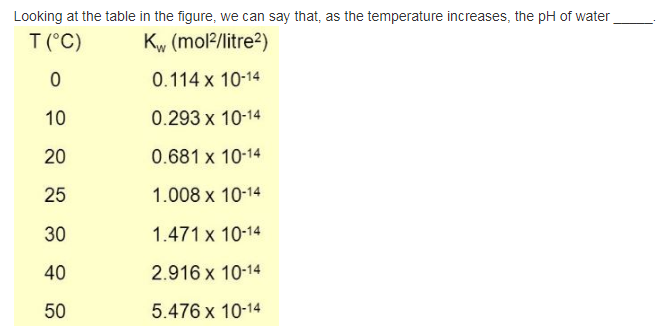
Looking at the table in the figure, we can say that, as the temperature increases, the pH of water _____.
Total Questions
12345678910111213141516171819202122232425262728293031323334
Question # 1
What is the percent ionization of 1.2 M HF solution? K a = 7.1 × 10 − 4
Question # 2
Methanoic acid reacts with water as in the following reversible reaction:
H C O O H + H 2 O ⇌ C O O H − + H 3 O +
Which of the following pairs comprises of acids, according to the Bronsted-Lowry definition?
Question # 3
Simplify
Question # 4
In Haber's process, for every 1 mole of nitrogen, how many moles of hydrogen are used, according to balanced equation?
Question # 5
A strong acid has a large Ka value. True or false?
Question # 6
Which of the following is TRUE for a weak acid?
Question # 7
A substance that donates a pair of electrons to form coordinate covalent bond is called _____.
Question # 8
KW is dependant on temperature. It _____ as temperature is decreased.
Question # 9
Identify the dissociation product of the following reaction? H + + H 2 O → ?
Question # 10
Chemical equilibrium state is _____.
Question # 11
Which change will shift the position of equilibrium to the right in this reaction? N 2 ( g ) + 3 H 2 ( g ) ⇌ 2 N H 3 ( g ) Δ H = − 92 k J
Question # 12
Which change(s) will increase the amount of S O 3 ( g ) at equilibrium? 2 S O 2 ( g ) + O 2 ( g ) ⇌ 2 S O 3 ( g ) Δ H = − 197 k J
Question # 13
what is the pH of pure water at this temperature?
Question # 14
In case of which of the following conditions, an equilibrium CANNOT be attained?
Question # 15
Which one of the following is equal to the pKa of a weak acid?
Question # 16
A mixture of CH3COOH and CH3COONa behaves as _____.
Question # 17
A mixture of N H 4 C l and N H 4 O H shows no change in pH upon addition of small amount of HCl. This is because it is _____.
Question # 18
The ionic product of water will increase if _____.
Question # 19
Which of the following properties is NOT necessarily required to be constant to attain a chemical equilibrium?
Question # 20
Choose the correct unit for equilibrium constant for dissociation of P C l 5 ?
Question # 21
We eat a variety of foods still pH of our blood does not change every time. The reason is _____.
Question # 22
Position of equilibrium will be towards left side if the value of Ka is _____.
Question # 23
For the reaction N 2 ( g ) + 3 H 2 ( g ) ⇌ 2 N H 3 ( g ) Δ H = − 92 k J What conditions will produce the highest percentage of ammonia at equilibrium?
Question # 24
H C O − 3 ( a q ) + H F ( a q ) ⇌ H 2 C O 3 ( a q ) + F − ( a q )
Which of the following is an acid-base pair in the reaction?
Question # 25
The catalyst used in Haber's process is _____.
Question # 26
A species which is able to accept a proton is called _____.
Question # 27
Role of NH4Cl in qualitative analysis of third group cations is _____.
Question # 28
In reverse reaction, what does SO3 decompose into?
Question # 29
What is the concentration of O H in a 0.20 M solution of ammonia?
Question # 30
Which of the following is FALSE about a strong base?
Question # 31
Which of the following statements is NOT true?
Question # 32
Three acids found in food are lactic acid (in milk products), oxalic acid (in rhubarb), and malic acid (in apples). The p K a values for lactic acid (LA), oxalic acid (OA) and malic acid (MA) are 3.88, 1.23, and 3.40 respectively. Which of these are in the order of decreasing acid strength?
Question # 33
Household ammonia has a H + concentration of 1 × 10− 12 M. How do you classify household ammonia?
Question # 34
Looking at the table in the figure, we can say that, as the temperature increases, the pH of water _____.
Total Questions
12345678910111213141516171819202122232425262728293031323334
Chemistry MCQ Test by Topics
- +8.1.0 Reversible and Irreversible Reactions
- +8.1.1 State of Chemical Equilibrium
- +8.1.2 Law of Mass Action
- +8.1.2.1 Units of Equilibrium Constants
- +8.1.3 Equilibrium Constant Expressions for Some Important Reactions
- +8.1.3.2 ii. Dissociation of PCl5 (gaseous phase reaction)
- +8.1.3.3 iii. Decomposition of N2O4 (gaseous phase reaction)
- +8.1.3.4 iv. Synthesis of NH3 ( gaseous phase reaction)
- +8.1.4 Relationship Between Equilibrium Constants
- +8.1.5 Applications of Equilibrium Constant
- +8.1.5.1 (i) Direction of Reaction
- +8.1.5.2 (ii) Extent of Reaction
- +8.1.5.3 (iii) The Effect of Conditions on the Position of Equilibrium
- +8.1.6 The Le-Chateliers Principle
- +8.1.6.1 (a) Effect of Change in Concentration
- +8.1.6.2 (b) Effect of Change in Pressure or Volume
- +8.1.6.3 (c) Quantitative Effect of Volume on Equilibrium Position
- +8.1.6.4 (d) Effect of Change in Temperature
- +8.1.6.5 (e) Effect of Catalyst on Equilibrium Constant
- +8.2 Applications of Chemical Equilibrium in Industry
- +8.2.1 Synthesis of Ammonia by Haber?s Process
- +8.2.2 Preparation of Sulphur Trioxide
- +8.3.0 IONIC PRODUCT OF WATER
- +8.3.1 pH and pOH
- +8.4.0 IONIZATION CONSTANTS OF ACIDS (Ka)
- +8.4.1 Percentage of Ionization of Acids
- +8.5.0 IONIZATION CONSTANT OF BASES (Kb)
- +8.5.1 pKa and pKb
- +8.6.0 Lowry Bronsted Acid and Base Concept
- +8.7 COMMON ION EFFECT
- +8.7.1 More Examples of Common Ion Effect
- +8.8.0 Buffer Solutions
- +8.8.0.1 (a) Why Do We Need Buffer Solution?
- +8.8.0.2 (b) How Do the Buffers Act?
- +8.8.0.3 Calculating the pH of a Buffer
- +8.8.1 Buffer Capacity
- +8.9.0 EQUILIBRIA OF SLIGHTLY SOLUBLE IONIC COMPOUNDS (SOLUBILITY PRODUCT)
- +8.9.1 Applications of solubility product
- +8.9.1.1 (a) Determination of Ksp, from solubility
- +8.9.1.2 (b) Determination of Solubility from Ksp
Chemistry



11th Class Online Classes 2026
Updated on: 14-10-2026
11th Class Online Preparation
11th Class 2026 Online
11th Class 2026
Add a Comment
Comments will be shown after admin approval.
Spam comments will not be approved at all.
Matric Result 2026 Punjab
10th Class Result 2026 Punjab
9th Class Result 2026 Punjab Boards
10th Class Result Gazette 2026 Punjab
Punjab Past Papers Matric 9th 10th
Primary Results 5th & 8th Class
BISE Results Intermediate & Matric
BISE Punjab Boards
Sindh Educational Boards
KPK Examination Boards
Technical Boards
Public Service Commission
University Results Gruaduation, Masters Classes
Subscribe by Email
Subscribe by Email
Subscribe to Rss Feed


Position Holders Matric 2026
Position Holders 9th Class 2026
Position Holders Inter 2026
Position Holders 11th Class 2026
Punjab 11th Class Chemistry