Chapter 6 Chemical Bonding Chemistry 11th Class Punjab MCQ Tests
11th Class Chemistry Chapter 6 MCQ Tests
Chapter 6 of 11th Class Chemistry has 30 questions. If you take an online MCQ test, the system will randomly choose the questions. If you want to take the quiz by chapter then click the start test button.
Total Questions: 30
Total Marks: 30
Time: 30 Mins
Total Questions: 30
Total Marks: 30
Time: 30 Mins
30Min : 00 Sec Remaining
Question # 1
The energy stored in chemical bonds is referred to as _____.
Question # 2
Which of the following atoms is biggest in size?
Question # 3
What will be the bond energy of 1 mole of H-Cl?

Question # 4
Which one of the following species contains a polar covalent bond?
Question # 5
Which of the following have their outer most shell complete in their atomic form?
Question # 6
Ionization results in the ejection of _____.
Question # 7
Which of the following atoms is smallest in size?
Question # 8
When an electron pair is shared between two atoms of equal electronegativity, _____.
Question # 9
When a gaseous isolated atom of fluorine gains an electron, a definite amount of energy is _____.
Question # 10
Which of the following properties does a covalent bond possess?
Question # 11
Which of the following statements describes why covalent bonding occurs?
Question # 12
Methanol, ethanol, and ammonia are soluble in water because _____.
Question # 13
What is the percentage of s-character in sp2 hybridization?
Question # 14
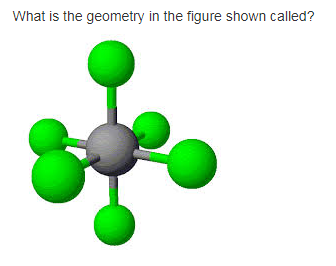
What is the geometry in the figure shown called?
Question # 15
The atomic radius is measured in _____.
Question # 16
Solid iodine would be most soluble in which of the following solvents?
Question # 17
Which of the following is used as measurement of the degree of polarity?
Question # 18
Which of the following terms describes a reaction in which more energy is released by bond formation than is consumed by bond cleavage?
Question # 19
Across a period (left to right), ionization energy _____.
Question # 20
Which of the following properties does an ionic bond possess?
Question # 21
Which of the following atoms is bigger in size?
Question # 22
What happens to the bond energy when electronegativity difference decreases between two covalently bonded atoms?
Question # 23
Negative sign is given to electron affinity because energy is _____.
Question # 24
Which one of these shows the highest percentage ionic character?
Question # 25
Which of the following bonds possesses the large dipole moment?
Question # 26
Which of the following molecules requires the highest bond energy?
Question # 27
Molecular orbital which has higher energy than atomic orbitals is called _____.
Question # 28
What do we call a phenomenon in which two or more compounds have same molecular formula but different structural formula?
Question # 29
An atom of hydrogen will lose or gain an electron in order to _____.
Question # 30
Size of ionic radius of anion as compared to atomic radius of the parent atom is _____.
Total Questions
123456789101112131415161718192021222324252627282930
Question # 1
The energy stored in chemical bonds is referred to as _____.
Question # 2
Which of the following atoms is biggest in size?
Question # 3
What will be the bond energy of 1 mole of H-Cl?
Question # 4
Which one of the following species contains a polar covalent bond?
Question # 5
Which of the following have their outer most shell complete in their atomic form?
Question # 6
Ionization results in the ejection of _____.
Question # 7
Which of the following atoms is smallest in size?
Question # 8
When an electron pair is shared between two atoms of equal electronegativity, _____.
Question # 9
When a gaseous isolated atom of fluorine gains an electron, a definite amount of energy is _____.
Question # 10
Which of the following properties does a covalent bond possess?
Question # 11
Which of the following statements describes why covalent bonding occurs?
Question # 12
Methanol, ethanol, and ammonia are soluble in water because _____.
Question # 13
What is the percentage of s-character in sp2 hybridization?
Question # 14
What is the geometry in the figure shown called?
Question # 15
The atomic radius is measured in _____.
Question # 16
Solid iodine would be most soluble in which of the following solvents?
Question # 17
Which of the following is used as measurement of the degree of polarity?
Question # 18
Which of the following terms describes a reaction in which more energy is released by bond formation than is consumed by bond cleavage?
Question # 19
Across a period (left to right), ionization energy _____.
Question # 20
Which of the following properties does an ionic bond possess?
Question # 21
Which of the following atoms is bigger in size?
Question # 22
What happens to the bond energy when electronegativity difference decreases between two covalently bonded atoms?
Question # 23
Negative sign is given to electron affinity because energy is _____.
Question # 24
Which one of these shows the highest percentage ionic character?
Question # 25
Which of the following bonds possesses the large dipole moment?
Question # 26
Which of the following molecules requires the highest bond energy?
Question # 27
Molecular orbital which has higher energy than atomic orbitals is called _____.
Question # 28
What do we call a phenomenon in which two or more compounds have same molecular formula but different structural formula?
Question # 29
An atom of hydrogen will lose or gain an electron in order to _____.
Question # 30
Size of ionic radius of anion as compared to atomic radius of the parent atom is _____.
Total Questions
123456789101112131415161718192021222324252627282930
Chemistry MCQ Test by Topics
- +6.1.0 Introduction
- +6.1.1 Cause of Chemical Combination
- +6.1.2 ENERGETICS OF BOND FORMATION
- +6.2 ATOMIC SIZES
- +6.2.0 ATOMIC RADII, IONIC RADII AND COVALENT RADII
- +6.2.1 Ionic Radii and Covalent Radii Ionic Radii
- +6.2.1.1 Ionic Radii
- +6.2.1.2 Covalent Radii
- +6.3 Ionization Energy,Electron Affinity and Electronegativity
- +6.3.1 Ionization Energy
- +6.3.1.1 Factors Influencing the Ionization Energies
- +6.3.1.2 Variation of Ionization Energy in the Periodic Table
- +6.3.1.3 Higher Ionization Energies
- +6.3.2 Electron Affinity
- +6.3.2.1 Factors Influencing the Electron Affinity
- +6.3.2.2 Variation in the Periodic Table
- +6.3.3 Electronegativity
- +6.3.3.1 Variation of Electronegativities in Periodic Table
- +6.4 TYPES OF BONDS
- +6.4.1 Lewis Concept
- +6.4.1.1 (i) Ionic Bond
- +6.4.1.2 (ii) Covalent Bond (electron pair bond)
- +6.4.1.2.1 Non-Polar Covalent Bonds
- +6.4.1.2.2 Polar Covalent Bonds
- +6.4.1.3 iii) Coordinate Covalent Bond
- +6.4.2 MODERN THEORIES OF COVALENT BOND
- +6.4.3 VALENCE SHELL ELECTRON PAIR REPULSION THEORY
- +6.4.3.2 Postulates of VSEPR Theory
- +6.4.3.2.1 Molecules Containing Two Electron Pairs (AB2 type)
- +6.4.3.2.2 Molecules Containing Three Electron Pairs ? (AB3 type:)
- +6.4.3.2.3 (iii) Molecules Containing Four Electron Pairs (AB4- Type:)
- +6.4.4 Valence Bond Theory (VBT)
- +6.4.5 Atomic Orbital Hybridization and Shapes of Molecules
- +6.4.5.1 (i) sp3 Hybridization
- +6.4.5.2 (b) Ammonia
- +6.4.5.3 (c) Water, H20
- +6.4.5.4 (ii) sp2- Hybridization
- +6.4.5.5 Bonding and Structure of Boron Trifluoride and Ethene
- +6.4.5.6 Bonding and Structure of Beryllium Dichloride and Ethyne
- +6.4.6 Molecular Orbital Theory
- +6.4.6.1 Head on Approach
- +6.4.6.2 Relative Energies of the Molecular Orbitals
- +6.4.6.3 Molecular Orbital Structures of Some Diatomic Molecules
- +6.4.6.4 (i) Helium, He2
- +6.4.6.5 (ii) Nitrogen, N2
- +6.4.6.6 (iii) Oxygen, O2
- +6.5 BOND ENERGY, BOND LENGTH AND DIPOLE MOMENT
- +6.5.1 Bond Energy (bond enthalpy)
- +6.5.2 Ionic Character and Bond Energy
- +6.5.3 Bond Length
- +6.5.4 Dipole Moment
- +6.5.5 Dipole Moments and Molecular Structure
- +6.5.5.1 Percentage Ionic Character
- +6.5.5.2 Bond Angles or the Geometry of Molecules
- +6.6 THE EFFECT OF BONDING ON THE PROPERTIES OF COMPOUNDS
- +6.6.1 (1) Solubility
- +6.6.2 (2) Isomerism
- +6.6.3 (3) Reaction Kinetics:
Chemistry






11th Class Online Classes 2026
Updated on: 14-10-2026
11th Class Online Preparation
11th Class 2026 Online
11th Class 2026
Add a Comment
Comments will be shown after admin approval.
Spam comments will not be approved at all.
Matric Result 2026 Punjab
10th Class Result 2026 Punjab
9th Class Result 2026 Punjab Boards
10th Class Result Gazette 2026 Punjab
Punjab Past Papers Matric 9th 10th
Primary Results 5th & 8th Class
BISE Results Intermediate & Matric
BISE Punjab Boards
Sindh Educational Boards
KPK Examination Boards
Technical Boards
Public Service Commission
University Results Gruaduation, Masters Classes
Subscribe by Email
Subscribe by Email
Subscribe to Rss Feed


Position Holders Matric 2026
Position Holders 9th Class 2026
Position Holders Inter 2026
Position Holders 11th Class 2026
Punjab 11th Class Chemistry