Chapter 3 Unit And Force Physics 11th Class Punjab Short Questions
Question No. 1 - An object is thrown vertically upward.Discuss the sign of acceleration due to gravity, relative to velocity, while the object is in air.
Answer No. 1 - When the object is thrown vertically upward, it will move against the direction of gravity. The sign of acceleration due to gravity relative to velocity will be taken as negative. When the object is moving downward, the sign of acceleration due to gravity will be positive.
Question No. 2 - Find on expression for horizontal rang of projectile?
Answer No. 2 - 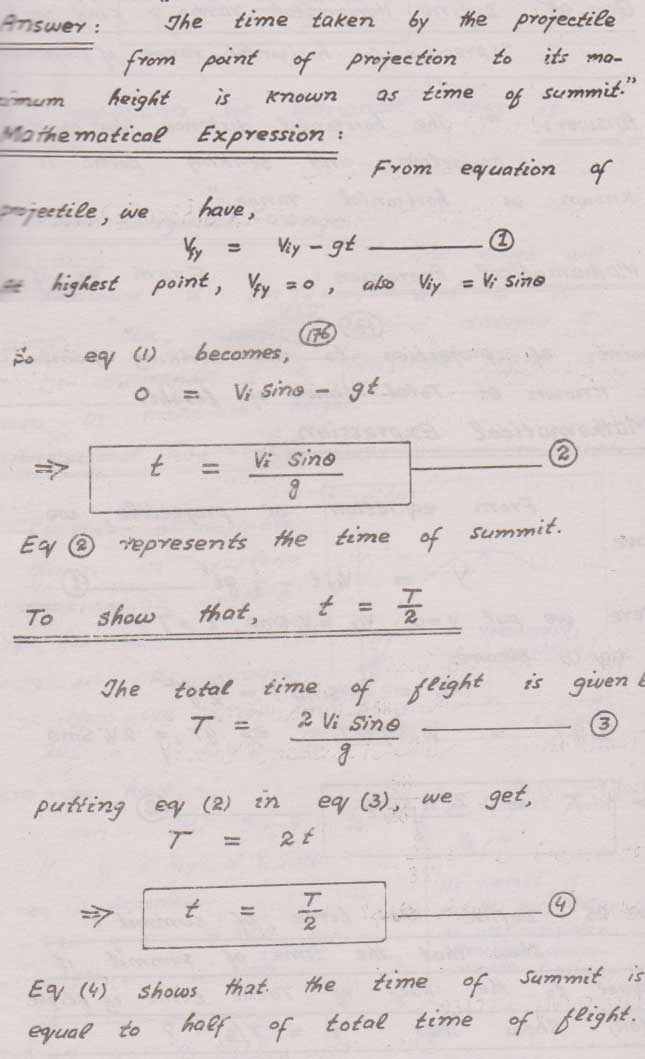
Question No. 3 - Why ballistic missiles are not useful for long ranges?
Answer No. 3 - Ballistic missiles are un-powered and unguided missiles. For long ranges, air friction is not negligible and some times the force of air friction is more than gravity. It affects both horizontal as well as vertical motions of the missile.
Question No. 4 - Define maximum height of projectile? Derive a mathematical expression for maximum height of projectile?
Answer No. 4 - 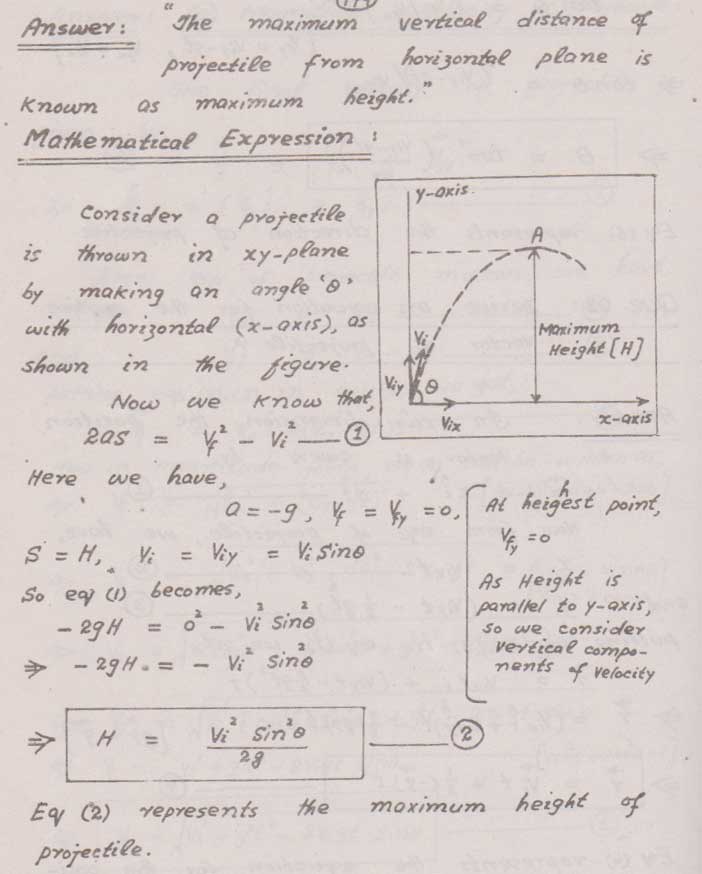
Question No. 5 - Under what conditions a body can move with uniform acceleration?
Answer No. 5 - If the velocity of the body is changing equally in equal intervals of time, the body is said to have uniform acceleration.
For a body moving with uniform acceleration, its average acceleration is equal to instantaneous acceleration.
For a body moving with uniform acceleration, its average acceleration is equal to instantaneous acceleration.
Question No. 6 - Define Force? Define its SI unit ?
Answer No. 6 - A Force is an agent which stops a moving body try to stop a moving body (or) which moves a stationary body (or) try to move stationary The Product of mass and accelerations known as force
F = ma
Unit of force:
F= ma = kg m/sec2So the unit of force is Newton, Which is define as,
Force is said to be 1 newton ,if it moves a body of mass 1 kg with acceleration of 1m/sec2.
F = ma
Unit of force:
F= ma = kg m/sec2So the unit of force is Newton, Which is define as,
Force is said to be 1 newton ,if it moves a body of mass 1 kg with acceleration of 1m/sec2.
Question No. 7 - Write two object?
Answer No. 7 - Velocity time graph can be used to:
1. Calculate the distance covered by the body.
2. Find the instantaneous acceleration of the body.
1. Calculate the distance covered by the body.
2. Find the instantaneous acceleration of the body.
Question No. 8 - Define elastic and inelastic collisions.
Answer No. 8 - Elastic collisions: A collision in which the K.E. Of the system is conserved is called elastic collision.
Inelastic collisions: A collision in which the K.E.of the system is not conserved is called inelastic collision.
Inelastic collisions: A collision in which the K.E.of the system is not conserved is called inelastic collision.
Question No. 9 - Under what condition, the instantaneous and average velocities of a moving object become equal?
Answer No. 9 - For a body moving with uniform velocity, its average and instantaneous velocities are equal.
Question No. 10 - Derive an equation for the position vector of projectile?
Answer No. 10 - 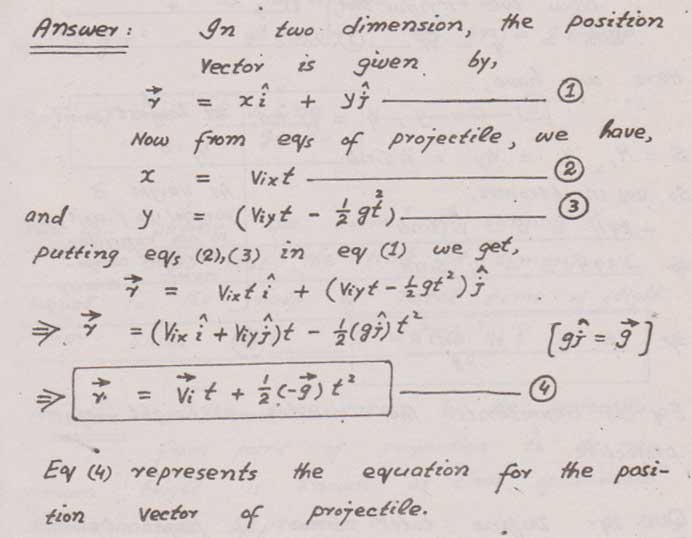
Question No. 11 - What is meant by perfectly elastic head-on-collision ?discuss the elastic collision in one dimension and find the mathematical equation for calculating the final velocities of colliding objects in one dimension?
Answer No. 11 - Perfectly elastic head-on-collision:The collision in which the motion of the objects occurs along a straight line is known as perfect elastic head-on-collision.Determination of mathematical equations for calculating the final velocities of colliding objects in one dimension.
Question No. 12 - Derive its equation of motion?
Answer No. 12 - 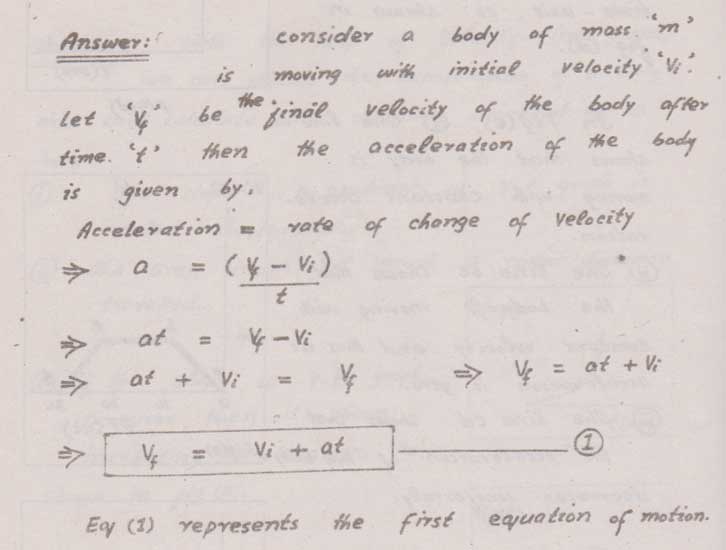
Question No. 13 - Why a safety helmet of a motor cycle's is padded?
Answer No. 13 - A motor cycle's safety helmet is padded so as to extend the time of collision to prevent serious injury.
Question No. 14 - Name the quantities which can be calculated from velocity-time graph and these can be calculated ?
Answer No. 14 - Distance moved by the body and its acceleration can be calculated by the velocity-time graph.
Area under the velocity time graph line is equal to the distance covered by the body. Slope of the tangent at any point gives the instantaneous acceleration at that point.
Area under the velocity time graph line is equal to the distance covered by the body. Slope of the tangent at any point gives the instantaneous acceleration at that point.
Question No. 15 - What is the effect on the speed of a fighter plane chasing another when it opens the fire? What happens to the speed of pursued plane when it returns the fire?
Answer No. 15 - When the fighter plane opens fire, its momentum will be in back direction due to reaction force in backwards direction and therefore its speed will decrease.
When the pursued plane opens fire in the backward direction, the momentum will act on the plane in forward direction due to reaction and therefore its speed will increase.
When the pursued plane opens fire in the backward direction, the momentum will act on the plane in forward direction due to reaction and therefore its speed will increase.
Question No. 16 - Show that for the same initial speed and some range of projectile there are two mutually complementary angles of projection?
Answer No. 16 - 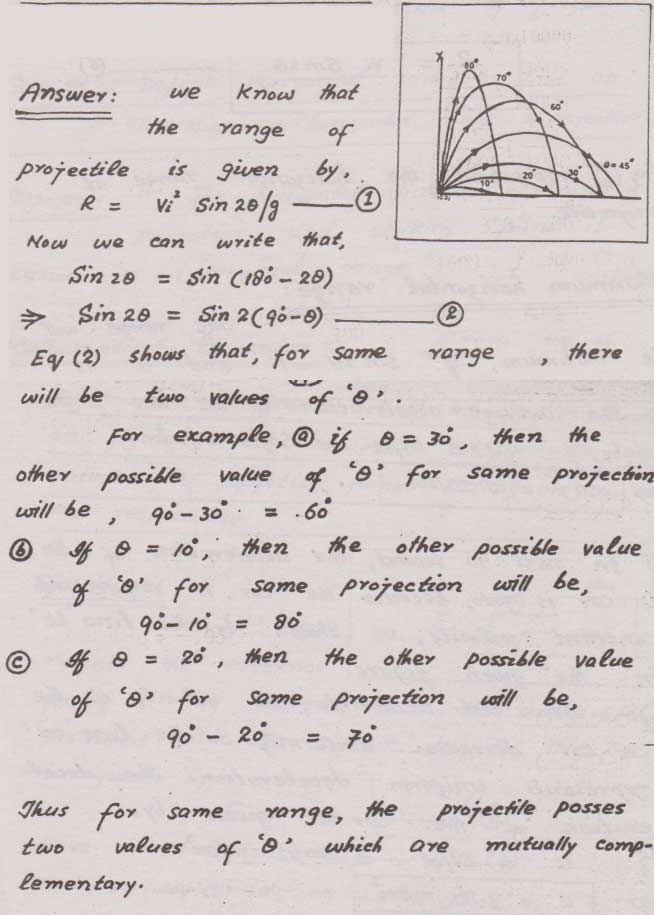
Question No. 17 - Behaviour of bouncing ball?
Answer No. 17 - When a hard ball is dropped onto a marble floor, it rebounds to very nearly the initial height. It loses negligible amount of energy in the collision with the floor.Then such collision is approximately an elastic collision. But if the ball is not able to reach the initial height such as collision with the sand then there is a loss of kinetic energy and such collision is called inelastic collision.
Question No. 18 - What is projectile motion? In what direction acceleration is zero in this motion?
Answer No. 18 - It is the two dimensional motion in which the object moves under constant acceleration due to gravity.
The acceleration in horizontal direction is zero in projectile motion.
The acceleration in horizontal direction is zero in projectile motion.
Question No. 19 - At what point or points in its path does a projectile have its minimum speed, its maximum speed?
Answer No. 19 - The speed of the projectile is minimum at the maximum height of projectile. It is because of the reason that; at maximum height the vertical component of velocity becomes zero.
The speed of the projectile is maximum at the point of projection and also just before it strikes the ground because the vertical component of velocity is maximum at these points.
The speed of the projectile is maximum at the point of projection and also just before it strikes the ground because the vertical component of velocity is maximum at these points.
Question No. 20 - Define the following terms?
Position, Uniforms, Speed, Variable Speed Average Speed and
Instantaneous Speed.
Answer No. 20 - Position:The location of an object relative to some reference point origin is known as position.
Speed:The distance between covered by a moving body in one second is known as speed
Speed = Distance covered /Time
The speed is a scalar quantity. Its S.I unit is " m/sec" .
Uniform Speed:A body is said to be moving with uniform speed, if it equal distance in equal intervals of time.
Variable Speed:A body is said to be moving with variable speed if it covers unequal distance in equal intervals of time.
Average Speed:The average speed of a moving body can be attained by dividing total distance covered by total time taken
Instantaneous Speed:The speed of a body at any particular instant of time is known as instantaneous speed.
Speed:The distance between covered by a moving body in one second is known as speed
Speed = Distance covered /Time
The speed is a scalar quantity. Its S.I unit is " m/sec" .
Uniform Speed:A body is said to be moving with uniform speed, if it equal distance in equal intervals of time.
Variable Speed:A body is said to be moving with variable speed if it covers unequal distance in equal intervals of time.
Average Speed:The average speed of a moving body can be attained by dividing total distance covered by total time taken
Instantaneous Speed:The speed of a body at any particular instant of time is known as instantaneous speed.
Question No. 21 - Discuss the velocity-Time Graph?
Answer No. 21 - 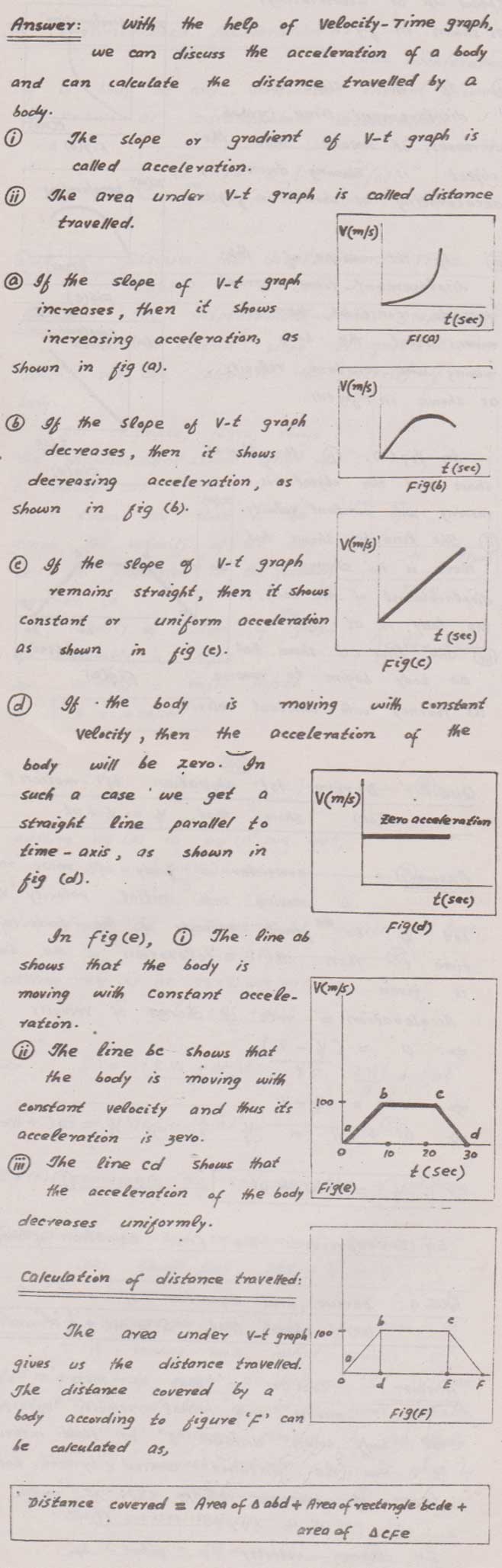
Question No. 22 - Define free fall motion? Also define the acceleration due to gravity ?
Answer No. 22 - If we drop an object from certain height height 'h' and ignore the air resistance then such motion of the body is known as free fall motion. the acceleration of free fall body is known as acceleration due to gravity.
It is represented by 'g' Its value varies with altitude and depth. On earth surface or near earth surface its value is 9.8 m/sec2.
It is represented by 'g' Its value varies with altitude and depth. On earth surface or near earth surface its value is 9.8 m/sec2.
Question No. 23 - Define ballistics flight and ballistic trajectory.
Answer No. 23 - The flight in which projectile is given an initial push and is then allowed to move freely due to inertia and under the action of gravity is called ballistic flight and the path followed by it is called ballistic trajectory.
Question No. 24 - State law of inertia?
Answer No. 24 - Newton's 1st law of motion is called law of inertia
It states that a body at rest will remain at rest , and a body moving with uniform velocity will continue to do so, unless acted upon by some unbalanced external force.
It states that a body at rest will remain at rest , and a body moving with uniform velocity will continue to do so, unless acted upon by some unbalanced external force.
Question No. 25 - How is the distance calculated from velocity time graph?
Answer No. 25 - Area under the velocity time graph line is equal to the distance covered by the body.
Question No. 26 - Define total of flight. Derive a mathematical expression for it?
Answer No. 26 - The term taken by projectile from point of projection to the striking point is known as total time of flight.
Question No. 27 - Define the following terms?
Velocity,
Uniform Velocity,
Variable Velocity,
Average Velocity.
Instantaneous Velocity.
Answer No. 27 - Velocity:The distance between covered by a body in one second along a particular direction is known as velocity.
V = S/t velocity is a vector quantity. its standard unit is \"m/sec
Uniform Velocity:A body is said to be moving with uniform velocity, if it covers equal displacement in equal intervals of time .
Variable Velocity:A body is said to be moving with variable velocity, if it covers unequal displacement in equal intervals of time.
Average Velocity:The average velocity can be obtained by dividing total displacement by total time taken.
Average velocity = Total Displacement /Total time taken
V = S/T
Instantaneous Velocity:The velocity of a body at any particular instant of time is known as instantaneous velocity.
V = S/t velocity is a vector quantity. its standard unit is \"m/sec
Uniform Velocity:A body is said to be moving with uniform velocity, if it covers equal displacement in equal intervals of time .
Variable Velocity:A body is said to be moving with variable velocity, if it covers unequal displacement in equal intervals of time.
Average Velocity:The average velocity can be obtained by dividing total displacement by total time taken.
Average velocity = Total Displacement /Total time taken
V = S/T
Instantaneous Velocity:The velocity of a body at any particular instant of time is known as instantaneous velocity.
Question No. 28 - Motion with constant velocity is a special case of motion with constant acceleration. Is this statement true?
Answer No. 28 - Yes, this statement is true. When a body moves with constant velocity in the straight line, its acceleration is zero.Hence,The acceleration of the body will always remain constant during such motion.As the zero is a constant quantity, therefore this is a special case of motion.
Question No. 29 - State Newton's third law of motion and give at least two examples.
Answer No. 29 - It states that every action has a reaction which is equal in magnitude but opposite in direction.An ideal elastic collision and propulsion of a rocket are two good examples of third law of motion.
Question No. 30 - Discuss the sign of acceleration due to gravity relative to velocity,while the object in in air?
Answer No. 30 - When the object is thrown vertically upward, it will move against the direction of gravity. The sign of acceleration due to gravity relative to velocity will be taken as negative.When the object is falling downward , it will move along the direction of gravity .
The sign of acceleration due to gravity relative to velocity will be taken as positive.
The sign of acceleration due to gravity relative to velocity will be taken as positive.
Question No. 31 - What is ballistic missile? Define ballistic trajectory.
Answer No. 31 - The missile in which it is given an initial push and is then allowed to move freely due to inertia and under the action of gravity is called ballistic and the path followed by such a projectile is called ballistic trajectory.
Question No. 32 - Derive the 3rd equation of motion?
Answer No. 32 - 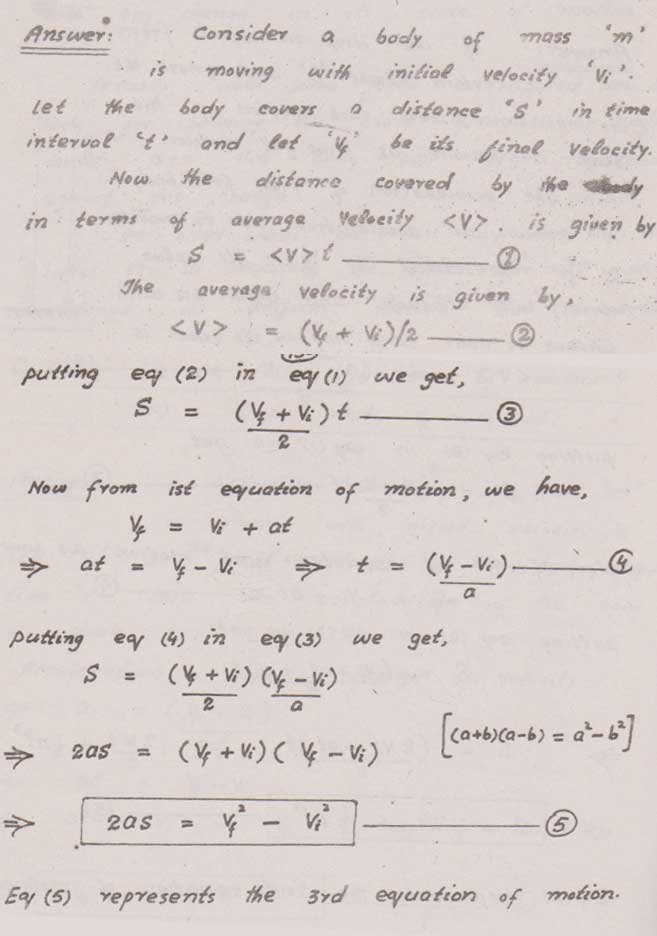
Question No. 33 - Discuss the displacement-time Graph?
Answer No. 33 - 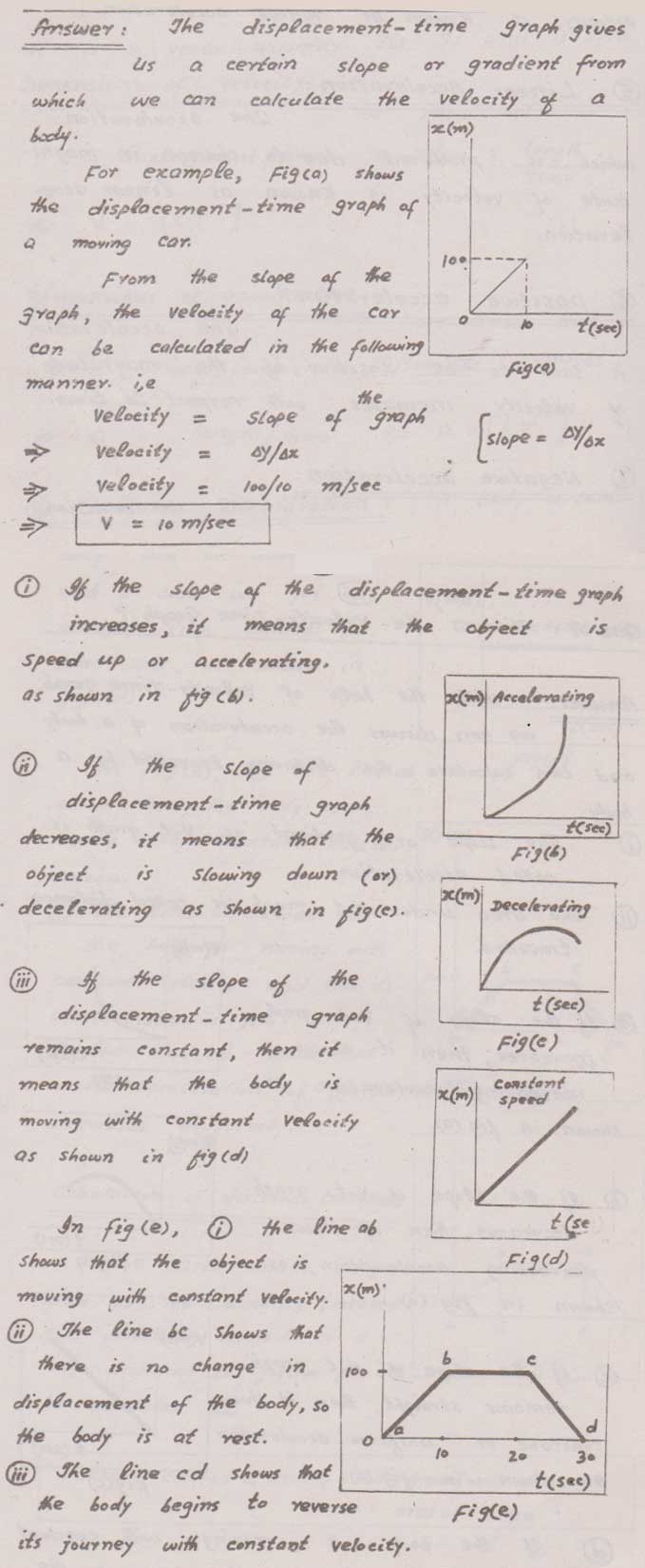
Question No. 34 - What is isolated system ? State and explain the law conservation of linear momentum. with an example ?
Answer No. 34 - Isolated System: A system which is not affected by external forces is known as an isolated system.
Law of conservation of linear Momentum:
Statement: This law states that, In the absence of external forces the total linear momentum of the system remains constant.
Example: Consider two bodies of masses 'm1, and m2 which are moving in the same direction along the same line, as shown in the figure
Law of conservation of linear Momentum:
Statement: This law states that, In the absence of external forces the total linear momentum of the system remains constant.
Example: Consider two bodies of masses 'm1, and m2 which are moving in the same direction along the same line, as shown in the figure
Question No. 35 - Discuss the condition of equilibrium ?
Answer No. 35 - Newtons 1st Law of motion: This Law states that "A body at rest will remain at rest and a body in motion will continue its motion with uniform velocity unless it is acted upon by some unbalanced external force
If F = 0 Then a = 0
Explanation: The Ist law of motion is also known as law of inertia. The inertia is the property of a body which opposes any change in its state of motion or rest. Actually, when some force is applied on a body for changing its state of rest or uniform motion, then the body will affer resistance against this change. In the word, We can say that all the bodies try to maintain its state of rest or continue its uniform motion due to inertia. That is the why the newtons Ist law is also known as law of inertia.
Examples:When we give a jerk to the branch of a tree, then the fruit falls down. It is because, when we give a jerk, the branch of the tree comes into motion suddenly.
When a bus starts motion suddenly, the passengers experience a push in the back ward direction It is because, when the bus starts motion suddenly, the lower parts of the passenger in contact with the seats also come into motion. while the upper parts of the passengers are at remain at the rest In this attempt, they falls in the back words directions
Newton's 2nd Law of motion:
Statements: This law states that, "when a force is applied on a body, then acceleration is produced in the body in the direction of applied force and inversely proportional to the mass of the body.
Explanation: The Ist Law of motion gives us the quantitative measurements of force, While the 2nd law of motion gives us the quantitative measurements of forces. now if the direction of motion of the body and direction of motion of the body and direction of forces are the same, then its velocity and acceleration increases. If the direction of motion of the body and direction of force are opposite in direction of force are opposite in direction, then the velocity and acceleration of the body will decreases gradually and finally become zero and the body will come to rest
Example of newtons 2nd law of motion:
When a body falls on a solid floor from the top of a building, the body experience or feel great pain. It is because, when the body falls on the floor, its acceleration become zero suddenly and the body faces huge force for very short period of time
Newton,s 3rd Law of motion:
This Law states that for every action, there is always a reaction. These forces are equal in magnitude but opposite in direction.
Explanation: This law tells us that no body can experience a force from its surrounding, until this body exerts any force on its surrounding It means That forces are exerted in pairs.
If F = 0 Then a = 0
Explanation: The Ist law of motion is also known as law of inertia. The inertia is the property of a body which opposes any change in its state of motion or rest. Actually, when some force is applied on a body for changing its state of rest or uniform motion, then the body will affer resistance against this change. In the word, We can say that all the bodies try to maintain its state of rest or continue its uniform motion due to inertia. That is the why the newtons Ist law is also known as law of inertia.
Examples:When we give a jerk to the branch of a tree, then the fruit falls down. It is because, when we give a jerk, the branch of the tree comes into motion suddenly.
When a bus starts motion suddenly, the passengers experience a push in the back ward direction It is because, when the bus starts motion suddenly, the lower parts of the passenger in contact with the seats also come into motion. while the upper parts of the passengers are at remain at the rest In this attempt, they falls in the back words directions
Newton's 2nd Law of motion:
Statements: This law states that, "when a force is applied on a body, then acceleration is produced in the body in the direction of applied force and inversely proportional to the mass of the body.
Explanation: The Ist Law of motion gives us the quantitative measurements of force, While the 2nd law of motion gives us the quantitative measurements of forces. now if the direction of motion of the body and direction of motion of the body and direction of forces are the same, then its velocity and acceleration increases. If the direction of motion of the body and direction of force are opposite in direction of force are opposite in direction, then the velocity and acceleration of the body will decreases gradually and finally become zero and the body will come to rest
Example of newtons 2nd law of motion:
When a body falls on a solid floor from the top of a building, the body experience or feel great pain. It is because, when the body falls on the floor, its acceleration become zero suddenly and the body faces huge force for very short period of time
Newton,s 3rd Law of motion:
This Law states that for every action, there is always a reaction. These forces are equal in magnitude but opposite in direction.
Explanation: This law tells us that no body can experience a force from its surrounding, until this body exerts any force on its surrounding It means That forces are exerted in pairs.
Question No. 36 - Find a relation for magnitude of velocity of projectile and direction of projectile?
Answer No. 36 - 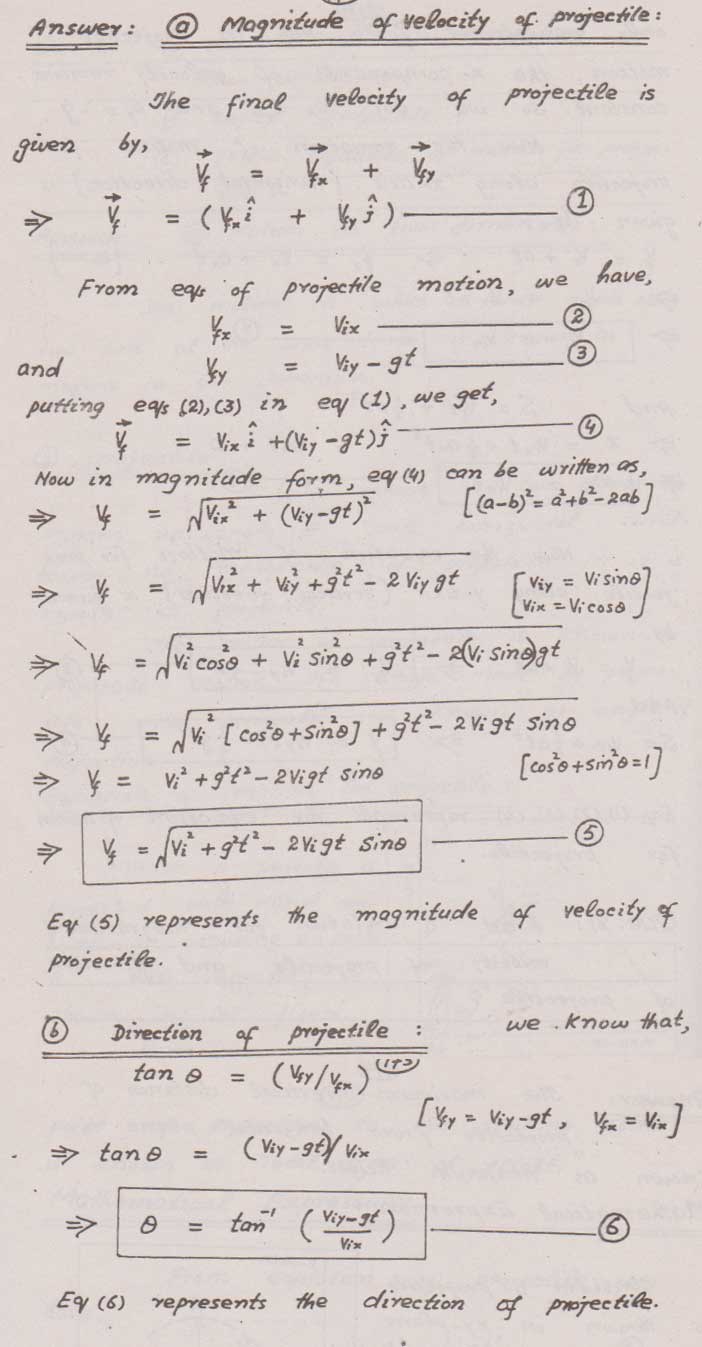
Question No. 37 - What is the difference between uniform and variable velocity?
Answer No. 37 - Uniform Velocity: A body is said to have a uniform velocity if it covers equal displacement in equal intervals of time.
Variable Velocity: A body is said to have a variable velocity if it covers unequal displacements in equal intervals of time.
Variable Velocity: A body is said to have a variable velocity if it covers unequal displacements in equal intervals of time.
Question No. 38 - Define rest and motion?
Answer No. 38 - Rest: A body is said to be at rest if it do not change its position with respect to the surrounding.
Motion: A body is said to be in motion if it change its position with respect to the surrounding.
Motion: A body is said to be in motion if it change its position with respect to the surrounding.
Question No. 39 - Distinguish between elastic and inelastic collision.
Answer No. 39 - In case of elastic collision the K.E of the system is conserved while in case of inelastic collision the K.E is not conserved. But the total linear momentum and the total energy of the system remains constant in both types of collision.
Question No. 40 - Write any two properties of inertial frame of reference.
Answer No. 40 - 1. A non-accelerated frame of reference is an inertial frame of reference.
2. Newton's 1st law of motion holds good in an inertial frame of reference.
2. Newton's 1st law of motion holds good in an inertial frame of reference.
Question No. 41 - What is the change in total energy during elastic or inelastic collisions?
Answer No. 41 - The total energy of the system remains conserved during both type of collisions. But in an inelastic collision, some of the kinetic energy is lost.
Question No. 42 - Define the following terms?
Acceleration
Uniform Acceleration
Variable Acceleration
Radical Acceleration
Linear Acceleration
Positive Acceleration
Negative Acceleration
Instantaneous Acceleration
Answer No. 42 - Acceleration:The rate of change of velocity is known as acceleration.
Mathematically, we have
Acceleration = v/t It is a vector quantity. It SI unit m/sec2
Dimensions of acceleration:We know that
V= Displacement / time = m/sec= Length / Time
V=[L T-1]
Dimensions of acceleration:We Known that
a = Velocity/time = m/sec . sec = m/sec-2
a = Length/time2 a = [L T-2]
Uniform Acceleration:A body is said to be moving with the uniform acceleration if equal change occurs in velocity in equal intervals of time.
Variable Acceleration:A body is said to be moving with variable Acceleration if unequal change occurs in velocity in equal intervals intervals of time.
Linear Acceleration:The acceleration which is produced due to change in magnitude of velocity is known as linear acceleration.
Radical Acceleration:The acceleration which is produced due to change indirection of velocity is known as radical acceleration.
Positive Acceleration:The acceleration is said to be positive if the magnitude of velocity increases with respect to time.
Negative Acceleration:The acceleration will be magnitude of velocity decreases with respect to time.
Instantaneous Acceleration:The acceleration of a body at any particular instant of time is known as instantaneous acceleration.
Mathematically, we have
Acceleration = v/t It is a vector quantity. It SI unit m/sec2
Dimensions of acceleration:We know that
V= Displacement / time = m/sec= Length / Time
V=[L T-1]
Dimensions of acceleration:We Known that
a = Velocity/time = m/sec . sec = m/sec-2
a = Length/time2 a = [L T-2]
Uniform Acceleration:A body is said to be moving with the uniform acceleration if equal change occurs in velocity in equal intervals of time.
Variable Acceleration:A body is said to be moving with variable Acceleration if unequal change occurs in velocity in equal intervals intervals of time.
Linear Acceleration:The acceleration which is produced due to change in magnitude of velocity is known as linear acceleration.
Radical Acceleration:The acceleration which is produced due to change indirection of velocity is known as radical acceleration.
Positive Acceleration:The acceleration is said to be positive if the magnitude of velocity increases with respect to time.
Negative Acceleration:The acceleration will be magnitude of velocity decreases with respect to time.
Instantaneous Acceleration:The acceleration of a body at any particular instant of time is known as instantaneous acceleration.
Question No. 43 - Can the velocity of an object reverse the direction when acceleration is constant? If so, given an example.
Answer No. 43 - Yes, the velocity of a body can reverse its direction with constant acceleration For example, when a body is thrown vertically upward under the action of gravity, the velocity of the object will go on decreasing because force of gravity is acting downward.
When the object reaches the maximum height , its velocity becomes zero, and then the object reverses its direction of motion and start moving vertically downward.During the whole process, the magnitude of the acceleration due to gravity remains constant.
When the object reaches the maximum height , its velocity becomes zero, and then the object reverses its direction of motion and start moving vertically downward.During the whole process, the magnitude of the acceleration due to gravity remains constant.
Question No. 44 - Derive the 2nd equation of motion?
Answer No. 44 - 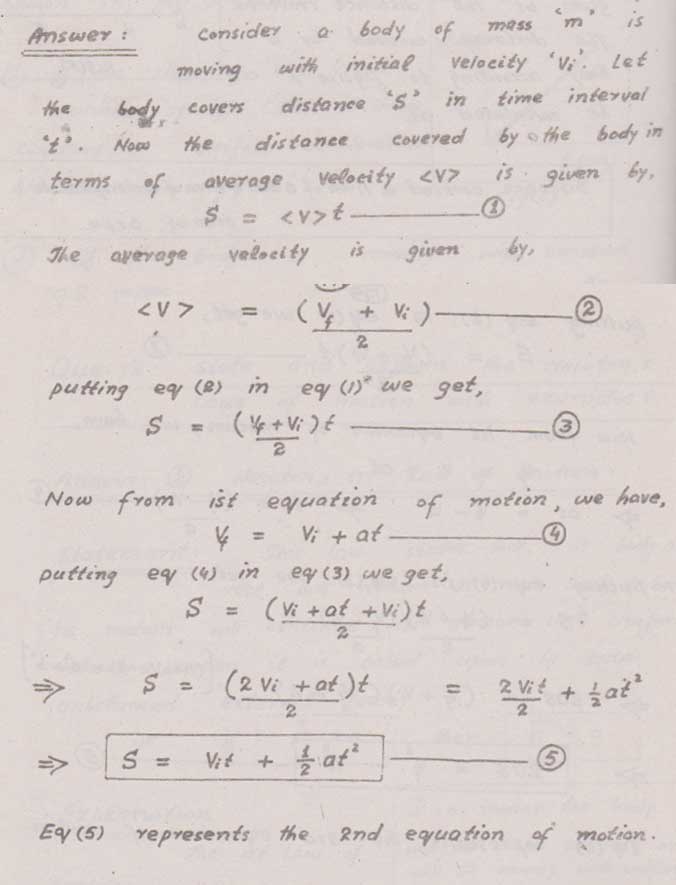
Question No. 45 - What is a Ballistic Flight?
Answer No. 45 - The flight in which projectile is given an initial push and is then allowed to move freely due to inertia and under the action of gravity is called ballistic flight and the path followed by it is called ballistic trajectory.
Question No. 46 - What is Ballistic Flight and Ballistic Missile?
Answer No. 46 - The flight in which projects is given an initial and is then allowed to move freely due to inertia and under the action of gravity is called ballistic flight.
Ballistic missile is an unpowered and unguided missile.The flight of Ballistic missile is Ballistic flight.
Ballistic missile is an unpowered and unguided missile.The flight of Ballistic missile is Ballistic flight.
Question No. 47 - Define Collision ? Discuss the type of collision?Give example in each case?
Answer No. 47 - Collision: When two or more than two bodies come so closer to each other that there exists some type of interaction between them in the presence or absence of external forces then such type of interaction is known as collision.
Type of Collision: There are two type of collision, which are given below.
Elastic Collision: The Collision in which the momentum and kinetic energy both are conserved is known as elastic collision.
Examples:
1. Collision of steel balls,
2. Collision of atoms,
3. Collision of molecules.
Inelastic Collision: The Collision in which the momentum is conserved but K.E is not conserved, is known as Inelastic collision.
In such type of collision, same type of the K.E is converted into internal energy, sound energy and the work needed to permanently deform the object involved, such as cars in a car crash.
Example:
1. Collision between two vehicles
2. Collision between two mud balls
Type of Collision: There are two type of collision, which are given below.
Elastic Collision: The Collision in which the momentum and kinetic energy both are conserved is known as elastic collision.
Examples:
1. Collision of steel balls,
2. Collision of atoms,
3. Collision of molecules.
Inelastic Collision: The Collision in which the momentum is conserved but K.E is not conserved, is known as Inelastic collision.
In such type of collision, same type of the K.E is converted into internal energy, sound energy and the work needed to permanently deform the object involved, such as cars in a car crash.
Example:
1. Collision between two vehicles
2. Collision between two mud balls
Question No. 48 - Write solid reasons for the loss of kinetic energy in an inelastic collision.
Answer No. 48 - In case of inelastic collision, the loss of kinetic energy is due to:
1. Friction of ball with floor
2. Friction of ball with air
3. Sound
1. Friction of ball with floor
2. Friction of ball with air
3. Sound
Question No. 49 - Why Newton's first law of motion is known as law of inertia?
Answer No. 49 - Newton's first law of motion is:
A body at rest will remain at rest and a body moving with uniform velocity will continue to do so unless acted upon by some unbalanced external force.
It is based on mass and inertia is the quantitative measure of an object's mass. So Newton's first law of motion is also Known as law of inertia.
A body at rest will remain at rest and a body moving with uniform velocity will continue to do so unless acted upon by some unbalanced external force.
It is based on mass and inertia is the quantitative measure of an object's mass. So Newton's first law of motion is also Known as law of inertia.
Question No. 50 - What is principle of rocket propulsion speed?
Answer No. 50 - Hot gases are expelled with extremely high velocity from the rocket engines. The gain in momentum of the gases equals the gain in momentum of the rocket. The gases and rocket move in opposite directions. This, the principle of rocket propulsion speed is law of conservation of momentum and Newton's 3rd law of motion.
Question No. 51 - What are the factors upon which force due to water depend?
Answer No. 51 - Force due to water flow depends upon viscosity of the media and velocity of the fluid.
Question No. 52 - Discuss the momentum changes produced by explosive forces?
Answer No. 52 - There are many cases where momentum changes are produced by explosive forces within an isolated system. It can be explain with the help of following.
Example:
When a shell explodes in mind-air its fragment fly apart in different direction. the various forces which occur in the explosion have zero resultant, because they cancel the effect of each other. so the total moments of the fragments is equal to the initial momentum of the shell.
Example:
When a shell explodes in mind-air its fragment fly apart in different direction. the various forces which occur in the explosion have zero resultant, because they cancel the effect of each other. so the total moments of the fragments is equal to the initial momentum of the shell.
Question No. 53 - Define Distance and displacement?
Answer No. 53 - Distance: The length of actual path traversed by a body in motion is known as distance. The actual path may be straight or cured. The distance is a scalar quantity. Its S.I units is meter.
Displacement: The shortest distance between is know as displacement.
A body reaches from point 'O' to 'C' through 'A" and 'B'. Thus the path 'OABC' represents the actual path traversed by the body during its motion. So it is called distance. While 'oc' represents the shortest distance between the initial point 'o' and final point 'c' It S.I unit is meter.
Displacement: The shortest distance between is know as displacement.
A body reaches from point 'O' to 'C' through 'A" and 'B'. Thus the path 'OABC' represents the actual path traversed by the body during its motion. So it is called distance. While 'oc' represents the shortest distance between the initial point 'o' and final point 'c' It S.I unit is meter.
Question No. 54 - Define inertial and non-inertial frame of references.
Answer No. 54 - Inertial Frame of References: The frame of reference in which Newton's first law holds is called inertial frame of reference. It is not an accelerated frame of reference.e.g,, Earth is approximately an inertial frame of reference.
Non-Inertial Frame of Reference: The frame of reference in which Newton's first law does not hold true is called non-inertial frame of reference.It is an accelerated frame of reference e.g., Space ship etc.
Non-Inertial Frame of Reference: The frame of reference in which Newton's first law does not hold true is called non-inertial frame of reference.It is an accelerated frame of reference e.g., Space ship etc.
Question No. 55 - Define linear momentum ? Express Newton,s 2nd Law in terms of momentum?
Answer No. 55 - 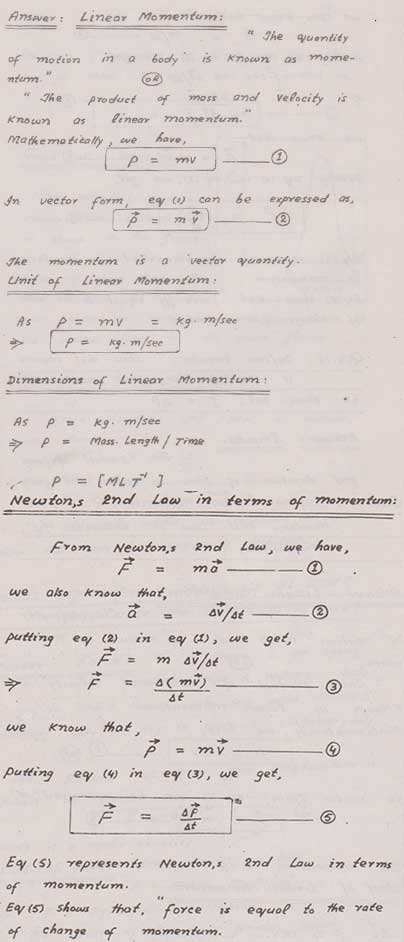
Question No. 56 - Define Impulse ? Show that impulse is equal to change in momentum show that J= P
Answer No. 56 - Impulse: The product of forces and duration of time in which the force acts is known as impulse.
Previous Question
1-56
Next Question
Physics
11th Class Punjab Short Questions










11th Class Online Classes 2026
Updated on: 14-10-2026
11th Class Online Preparation
11th Class 2026 Online
11th Class 2026
Add a Comment
Comments will be shown after admin approval.
Spam comments will not be approved at all.
Matric Result 2026 Punjab
10th Class Result 2026 Punjab
9th Class Result 2026 Punjab Boards
10th Class Result Gazette 2026 Punjab
Punjab Past Papers Matric 9th 10th
Primary Results 5th & 8th Class
BISE Results Intermediate & Matric
BISE Punjab Boards
Sindh Educational Boards
KPK Examination Boards
Technical Boards
Public Service Commission
University Results Gruaduation, Masters Classes
Subscribe by Email
Subscribe by Email
Subscribe to Rss Feed


Position Holders Matric 2026
Position Holders 9th Class 2026
Position Holders Inter 2026
Position Holders 11th Class 2026