Chapter 2 Vectors And Equilibrium Physics 11th Class Punjab Short Questions
Question No. 1 - What is difference between moment arm and moment of force?
Answer No. 1 - The perpendicular distance from the line of action of force to the axis of rotation is called moment arm.
1. The turning effect of a force about a fixed axis is called moment of force or torque.
2. S.I unit of moment arm is meter while moment of force is measured in Nm.
3. The dimensions of moment arm are [L] while the dimension of moment of force are [MLT-2]
1. The turning effect of a force about a fixed axis is called moment of force or torque.
2. S.I unit of moment arm is meter while moment of force is measured in Nm.
3. The dimensions of moment arm are [L] while the dimension of moment of force are [MLT-2]
Question No. 2 - Define unit vector?
Answer No. 2 - A vector whose magnitude is one is known as unit vector.
Question No. 3 - Two vectors have unequal magnitude.Can their components be equal in magnitude?
Answer No. 3 - No, the components of two vectors cannot be equal in magnitude if the two vector have unequal magnitudes.
Question No. 4 - Define and explain position vector?
Answer No. 4 - 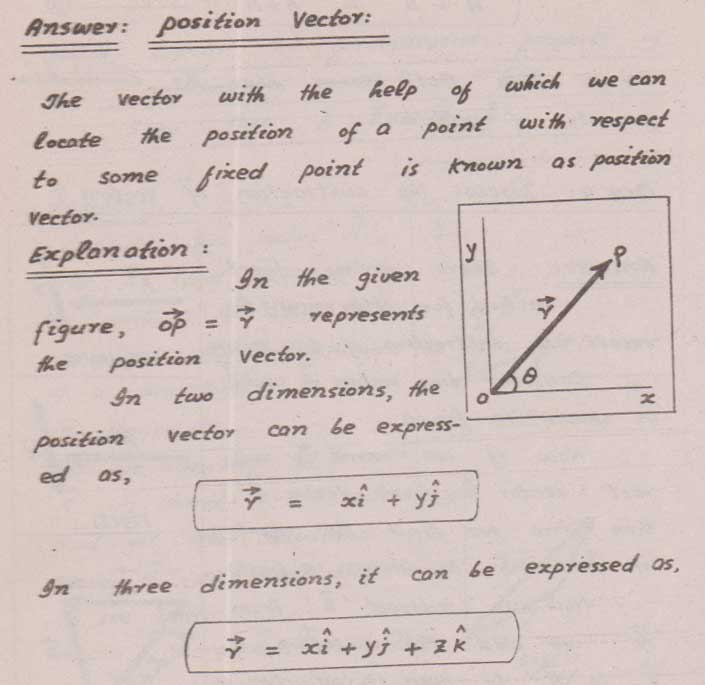
Question No. 5 - Why can a vector not have a component greater than the vectors magnitude?
Answer No. 5 - The magnitude of the components of a vector can not be greater than the vectors magnitude because component is always a part of the resultant vector. This relation show that if any two components of a vector are zero then the magnitude of the third components may be equal to the vectors magnitude but it can never be greater.
Question No. 6 - State condition of rotational equilibrium.
Answer No. 6 - The vector sum of all torque acting on any object must be zero.
When this condition of equilibrium is satisfied, there is no angular acceleration and body will be in rotational equilibrium.Hence, a body cannot rotate about center of gravity under the action of its weight.
When this condition of equilibrium is satisfied, there is no angular acceleration and body will be in rotational equilibrium.Hence, a body cannot rotate about center of gravity under the action of its weight.
Question No. 7 - Can a vector have a component greater than the vector\'s magnitude?
Answer No. 7 - No the magnitude of the component of a vector can never be greater than the vector\'s magnitude. The maximum value of magnitude of component can be equal to the magnitude of the vector.
Question No. 8 - Define the term unit vector.
Answer No. 8 - Vector having the unit magnitude is called the unit vector. It is used to indicate the direction of a given vector.
Question No. 9 - Is it possible to add a vector quantity to a scalar quantity?
Answer No. 9 - No it is not possible to add a vector quantity to a scalar quantity because the physical quantities of same nature can be added. Vectors can be added to vectors and scalars are added in scalars, but the vectors can't be added to scalar.
Question No. 10 - Define unit vector.How we find it?
Answer No. 10 - A unit vector in a given direction is a vector with magnitudes one in that direction. Its is used to represent the direction of a vector.
Question No. 11 - Mention the criterion for positive and negative torque.
Answer No. 11 - Positive torque: Anti-Clockwise torque is taken as positive.
Negative torque: Clockwise torque is taken as negative.
Negative torque: Clockwise torque is taken as negative.
Question No. 12 - What are rectangular components of a vector?
Answer No. 12 - The components of a vector which are perpendicular to rectangular components. Each other are called rectangular components of a vector.
Question No. 13 - Discuss, how a vector is represented?
Answer No. 13 - A vector is usually represented by the following two method.
Graphical representation:Graphically, a vector is represented by a bold straight line having an arrow head at its one end. The arrow indicates the direction of the given vector.
Symbolic representation:Symbolic, a vector is represented by any English alphabet having on arrow head upon it.
Graphical representation:Graphically, a vector is represented by a bold straight line having an arrow head at its one end. The arrow indicates the direction of the given vector.
Symbolic representation:Symbolic, a vector is represented by any English alphabet having on arrow head upon it.
Question No. 14 - Discuss the multiplication of a vector by a number?
Answer No. 14 - We can multiple a vector by a number. If the number is positive, then the direction of given vector and product vector will remain the same. If the number id negative, then the given vector and product vector will be acting in opposite direction.
Question No. 15 - What is the minimum number of unequal vector in to a null vector? Explain.
Answer No. 15 - The minimum number of unequal vector to result in to a null vector must be three. If we add three vector of unequal magnitude in such a way that they forms the sides of a triangle, then their resultant must be zero.
In the given figure three vectors A, B, and C are added according to head to tail rule and they form the side of a triangle. Now for getting their resultant, we will combine the tail of A with the head of C which already coincides each other. Thus we get a null vector or zero vector as a resultant
R= A+B+C = 0
In the given figure three vectors A, B, and C are added according to head to tail rule and they form the side of a triangle. Now for getting their resultant, we will combine the tail of A with the head of C which already coincides each other. Thus we get a null vector or zero vector as a resultant
R= A+B+C = 0
Question No. 16 - Discuss the addition of vector by rectangular component method?
Answer No. 16 - 
Question No. 17 - Can you add zero to a null vector?
Answer No. 17 - No, zero can't be added to a null vector because zero is a scalar and scalars can't be added to vectors Only the physical quantities of same nature can be added.
Question No. 18 - Discuss the condition of equilibrium?
Answer No. 18 - There are two condition of equilibrium which are given below.First Condition of equilibrium:According to the first condition of equilibrium, a body is said to be in equilibrium, if the vector sum of all external forces acting on the body is zero they cancel the effect of each other { F = 0In the component form we haveF1y+ F2y + F3y +................ +Fny =0Fy = 0A book lying on the table and paratrooper moving down words with uniform Velocity satisfies the first condition of equilibrium.Second Condition of Equilibrium:According to the condition of equilibrium, a body is said to be in equilibrium on a body is equal to zero.{ T = 0Explanation:There are certain situation in which on extended body will not be in equilibrium even when the first condition of equilibrium is satisfied. For Example, in the two equal forces are acting on a meter rod in opposite direction. As the line of action of these forces are not the same so the meter rod do not remain in state equilibrium and begins to rotate in anti clock wise direction. So the first condition of equilibrium is not sufficient in such a case Under such situations we should arrange the forces on the body in such a way, htat they causes clock-wise torque and anti-clock wise torque acting on the body simultaneously and cancel the effect other.
Question No. 19 - What is the minimum number of unequal vector in to a null vector?
Answer No. 19 - The minimum number of unequal vector to result in to a null vector must be three. If we add three vector of unequal magnitude in such a way that they forms the sides of a triangle, then their resultant must be zero.
In the given figure three vectors A, B, and C are added according to head to tail rule and they form the side of a triangle. Now for getting their resultant, we will combine the tail of A with the head of C which already coincides each other. Thus we get a null vector or zero vector as a resultant
R= A+B+C = 0
In the given figure three vectors A, B, and C are added according to head to tail rule and they form the side of a triangle. Now for getting their resultant, we will combine the tail of A with the head of C which already coincides each other. Thus we get a null vector or zero vector as a resultant
R= A+B+C = 0
Question No. 20 - What are coplanar and concurrent forces?
Answer No. 20 - Coplanar Forces: All the forces lying in the same plane are called coplanar forces.
Concurrent forces: All the forces acting on the same point are called concurrent forces.
Concurrent forces: All the forces acting on the same point are called concurrent forces.
Question No. 21 - Can a body rotate about its center of gravity under the action of its weight?
Answer No. 21 - No a body cannot rotate about its center of gravity under the action of its weight.Because the whole weight of the body acts on its center of gravity. The moment arm is zero in this case.
Question No. 22 - Define null vector and component of a vector.
Answer No. 22 - Null Vector is a vector of zero magnitude and arbitrary direction.
A component of a vector is its effective vale in a given direction.
A component of a vector is its effective vale in a given direction.
Question No. 23 - Discuss the addition of vectors by graphical Method or geometrical Method?
Answer No. 23 - We can add two or more than two vectors by geometrical method or graphical method to get their resultant vector. we use "Head-to-Tail rule for addition of vectors by graphical method or geometrical method.
The following steps must be followed to add vectors buy head-to-tail rule:
1. Select a suitable scale for the representation of given vectors
2. Draw the 1st vector according to the selected scale in the given direction
3. Draw the second vector according to the selected scale in the specified direction such that its tail touches the head of the first vector.
4. Now draw the 3rd vector according to the selected scale in the specified direction such that its tail touches the head of the second vector
5. Continue the above process for given number of vectors.
6. For getting the resultant vector, combination the tail of the first vector.
7. Measure the length of R which will given its magnitude.
8. To determine the direction of R measure the angle of R with respect to positive X-direction in anti clock wise sense.
The following steps must be followed to add vectors buy head-to-tail rule:
1. Select a suitable scale for the representation of given vectors
2. Draw the 1st vector according to the selected scale in the given direction
3. Draw the second vector according to the selected scale in the specified direction such that its tail touches the head of the first vector.
4. Now draw the 3rd vector according to the selected scale in the specified direction such that its tail touches the head of the second vector
5. Continue the above process for given number of vectors.
6. For getting the resultant vector, combination the tail of the first vector.
7. Measure the length of R which will given its magnitude.
8. To determine the direction of R measure the angle of R with respect to positive X-direction in anti clock wise sense.
Question No. 24 - A point object acted on by forces 4N, 5N, and 6N is in equilibrium. If 6N force is removed, what is the resultant force on the object?
Answer No. 24 - 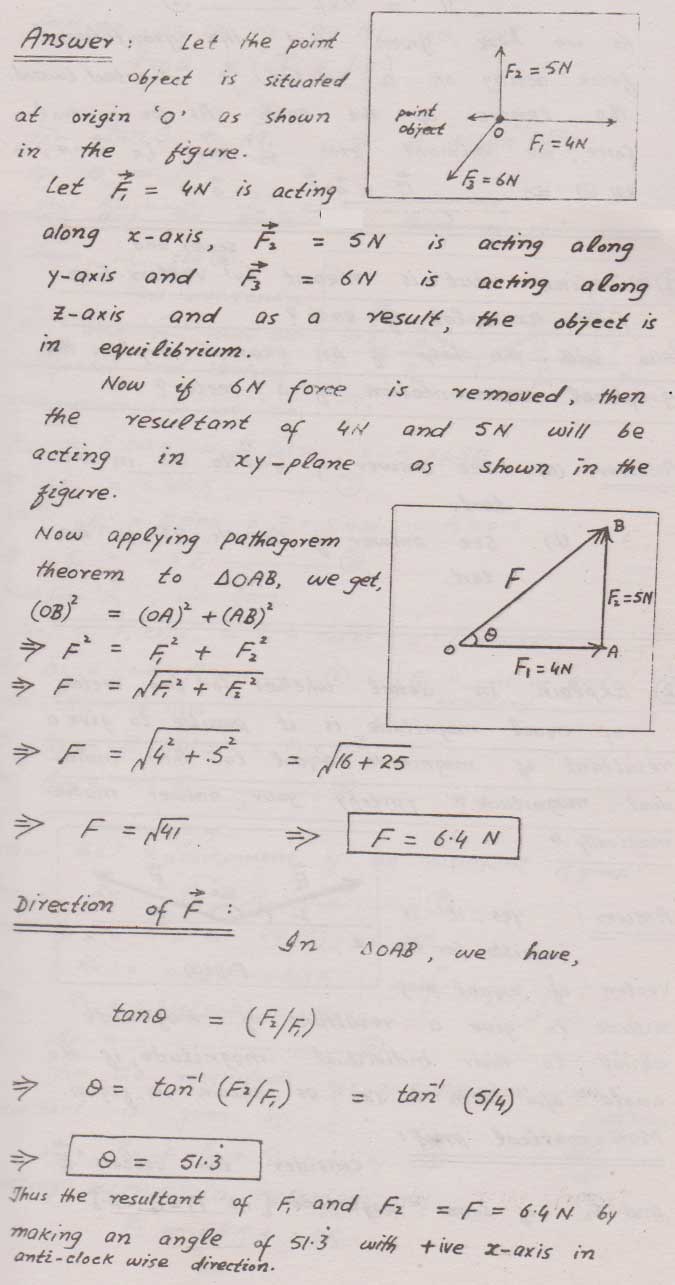
Question No. 25 - Define null and equal vectors.
Answer No. 25 - Null vector: A vector of zero magnitude and arbitrary direction is called null vector.
Equal vector: Two vectors are said to be equal if they have same magnitude direction.
Equal vector: Two vectors are said to be equal if they have same magnitude direction.
Question No. 26 - The resultant of two vector, one is double in magnitude than the other, perpendicular to the smaller force. What is the angle between the two forces?
Answer No. 26 - 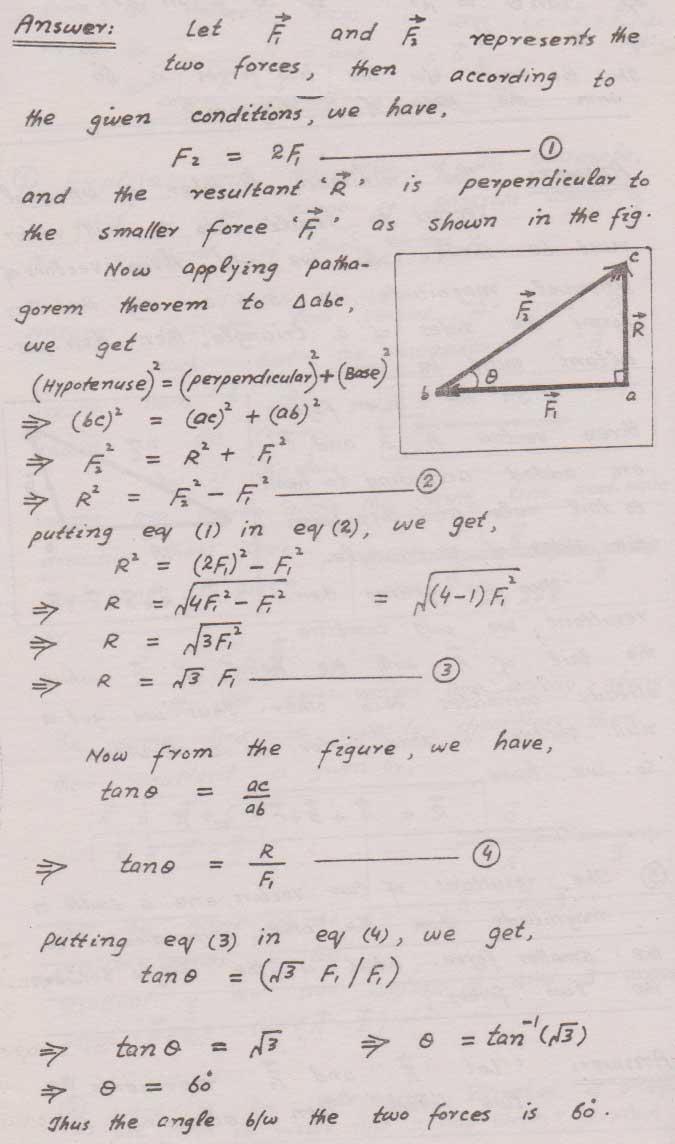
Question No. 27 - Define equilibrium?
Answer No. 27 - Equilibrium: The state of a body, under the action of several forces acting together and there is no change in the translation motion as well as its rotational motion is known as equilibrium.
Question No. 28 - Define and explain the resolution of a vector?
Answer No. 28 - 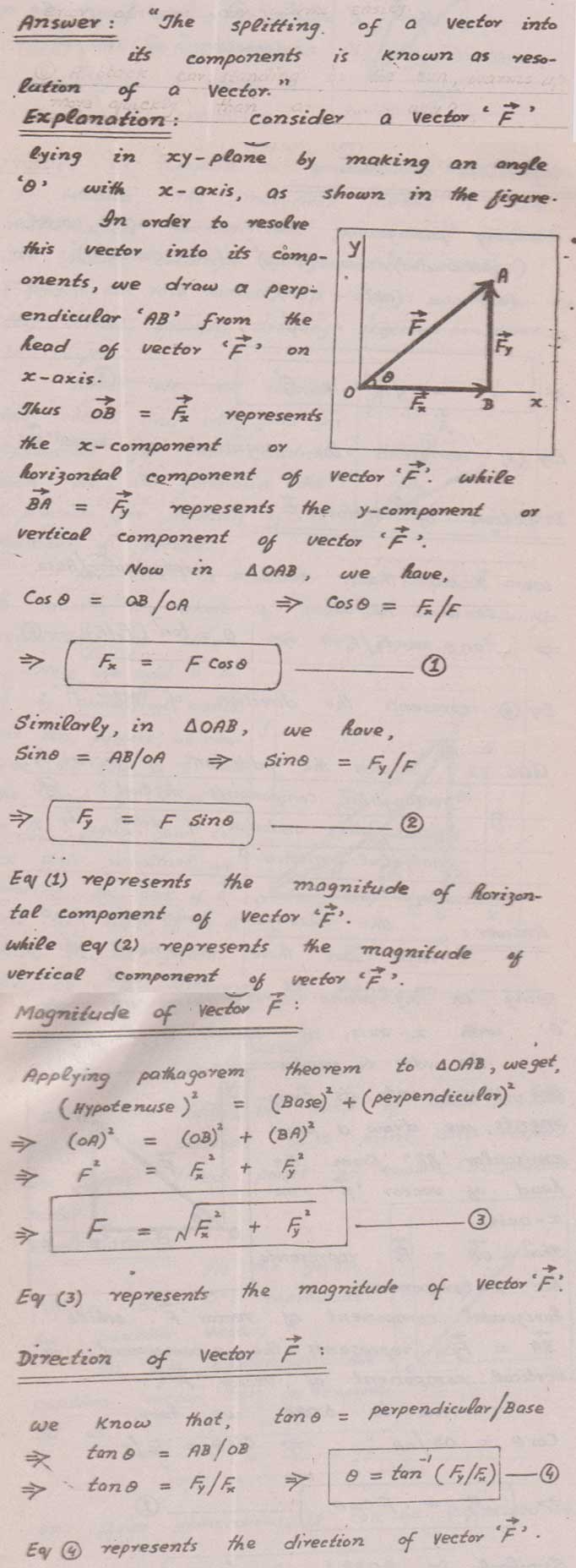
Question No. 29 - Define and explain the scalar product?
Answer No. 29 - 
Question No. 30 - Define scalar and vector quantities?
Answer No. 30 - Scalar Quantities: Those quantities which are completely specified by their magnitude only, are known as scalar quantities. For example Speed, Mass, energy, work, power.
Vector Quantities: Those physical quantities which are completely specified by their magnitude and proper direction are known as vector quantities. For example Momentum, Acceleration, torque.
Vector Quantities: Those physical quantities which are completely specified by their magnitude and proper direction are known as vector quantities. For example Momentum, Acceleration, torque.
Question No. 31 - Define and explain vector product? (or) Cross Product.
Answer No. 31 - 
Question No. 32 - The gravitational Force acting on a satellite is always directed towards the centre of the earth?
Answer No. 32 - We known that the torque depends upon the moments arm and applied force. Mathematically we have
T = r*F
As we have given that the gravitational force acting on a satellite is directed towards the centre of the earth. As for central force, the moment arm is zero r= 0 so T = o*F = 0
T= 0
Eq (2) shows that the torque produced by gravitational force acting on a satellite zero
T = r*F
As we have given that the gravitational force acting on a satellite is directed towards the centre of the earth. As for central force, the moment arm is zero r= 0 so T = o*F = 0
T= 0
Eq (2) shows that the torque produced by gravitational force acting on a satellite zero
Question No. 33 - Explain rectangular coordinates system.
Answer No. 33 - Two lines drawn at right angles to each other are know as coordinate axes and their point of intersection is known as origin. This system of coordinate axes is called rectangular coordinate system.
The horizontal line is named x-axis and vertical line y-axis.The direction of x-axis is positive towards right and y-axis is positive upward.
The horizontal line is named x-axis and vertical line y-axis.The direction of x-axis is positive towards right and y-axis is positive upward.
Question No. 34 - Two vector of magnitude 10 each making angle 180° With each other.Find the magnitude of their resultant.
Answer No. 34 - We know that the sum of two vectors which are equal in magnitude and opposite in direction is zero.
Two vectors of magnitude 10 each making angle 180° With each other are in opposite direction.Therefore, the magnitude of their resultant will be equal to zero.
Two vectors of magnitude 10 each making angle 180° With each other are in opposite direction.Therefore, the magnitude of their resultant will be equal to zero.
Question No. 35 - Discuss the subtraction of vector ?
Answer No. 35 - 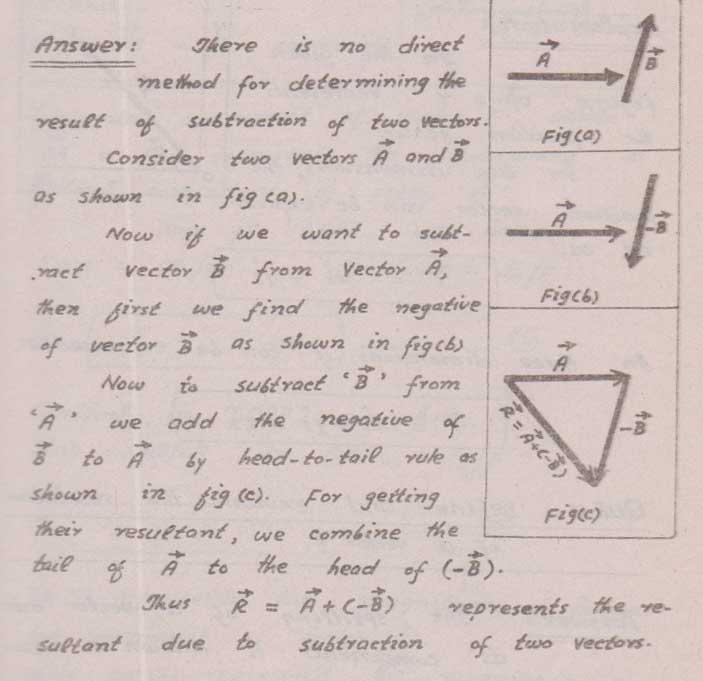
Question No. 36 - Define Physical quantities & Magnitude?
Answer No. 36 - Physical Quantities: Those quantities which can be measured are known as physical quantities. For example, length, mass, temperature, speed, velocity, acceleration, energy , torque etc.
Magnitude: A number with proper unit is known as magnitude for example, 100 kg, 50 N, 1000 m etc.
Magnitude: A number with proper unit is known as magnitude for example, 100 kg, 50 N, 1000 m etc.
Question No. 37 - Two vectors have unequal magnitude. Can their sum be zero? Explain.
Answer No. 37 - No, the sum of two vectors having unequal magnitudes can't be zero. The sum of two vectors will be zero only when their magnitudes are equal and they act in opposite direction.
Question No. 38 - Discuss the commutative property of addition of vectors ?
Answer No. 38 - 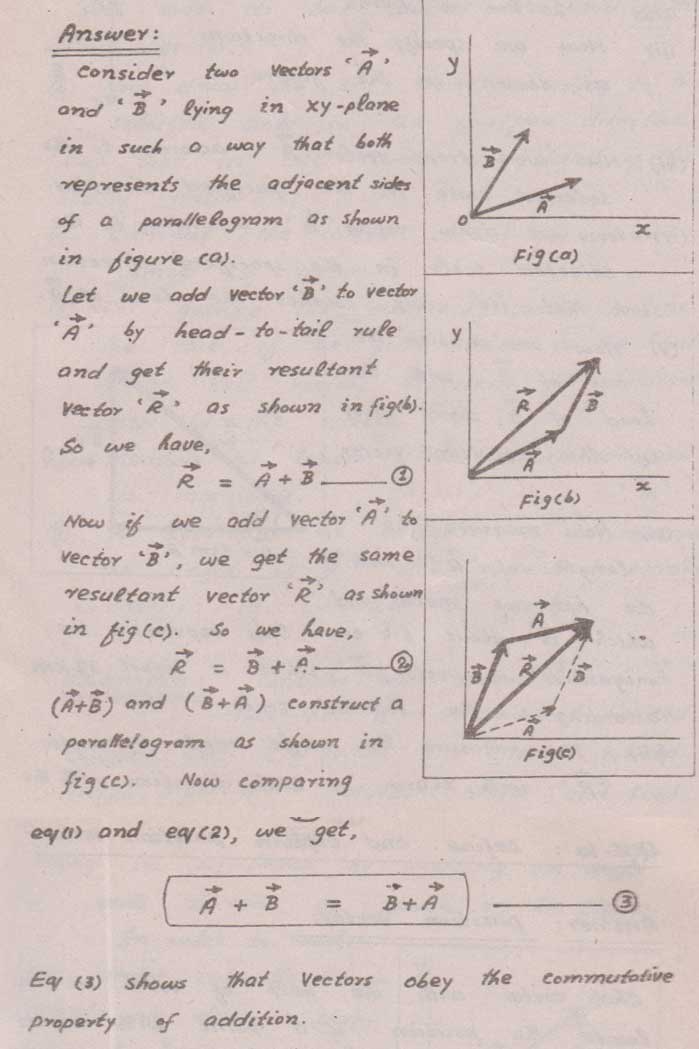
Question No. 39 - Define Torque (or) Moment of force?
Answer No. 39 - The turning effect produced in a body about a fixed point due to an applied force is known as torque (or) Moment of force.
Question No. 40 - You are falling off the edge. What should you do to avoid falling?
Answer No. 40 - You should bend yourself backward to avoid falling off the edge. Because of this center of gravity will shift backward.
Question No. 41 - Write down the steps for addition of vectors by rectangular components method.
Answer No. 41 - 1. Find x and y components of all given vectors.
2. Find Rx by adding x-components of all the vectors.
3. Find RY adding y-components of all the vectors.
2. Find Rx by adding x-components of all the vectors.
3. Find RY adding y-components of all the vectors.
Question No. 42 - What do you mean by concurrent force? Explain with examples?
Answer No. 42 - Concurrent Force:Two or more than two force are said to be concurrent force, If they are acting upon a body and their lines of action passes through a common point.Explanation:Consider a bulb which is suspended by means of a thread from a rigid support In this case the weight 'w' of the bulb is acting in down wards direction while the tension 'T' in the thread is acting of both forces passes through the same point or common point. Both forces balance each other and as a a result the bulb remain the state of equilibrium such force are know as concurrent forces.
Question No. 43 - Define position vector and resultant vector.
Answer No. 43 - Position Vector: A vector which describes the location of a point with respect to origin is called position vector.
Resultant Vector: A Single vector which would have the same effect as all the original vectors taken together.
Resultant Vector: A Single vector which would have the same effect as all the original vectors taken together.
Question No. 44 - Why can a body not rotate about its centre of gravity under the action of its weight?
Answer No. 44 - As we know that the centre of gravity is that point at which the whole weight of the body acts. In this case, the line of action of force (weight) passes the pivot point (centre of gravity). Therefore, moment arm is zero. As a result torque is also zero.
Question No. 45 - How would the two vectors of the same magnitudes have to be oriented,if they were to be combined to give a vector of the same magnitude?
Answer No. 45 - The two vectors of equal magnitudes are combined to give a resultant vector of same magnitude when must be oriented at an angle of 1200 With each other.
Question No. 46 - Explain why do buses and heavy trucks have large steering wheels?
Answer No. 46 - We know that the magnitude of torque depends upon the moment arm and applied force T = r * f
Show that to produce greater torque with a less applied force, the value of moment arm 'r' must be taken as larger due to greater torque, we can turn the heavy trucks and buses have large steering wheels to produce greater torque and to make the drive more easy.
Show that to produce greater torque with a less applied force, the value of moment arm 'r' must be taken as larger due to greater torque, we can turn the heavy trucks and buses have large steering wheels to produce greater torque and to make the drive more easy.
Question No. 47 - Differentiate between static and dynamic equilibrium.
Answer No. 47 - Static Equilibrium: If a body is at rest, then it is said to be in static equilibrium.
Dynamic Equilibrium: If the body is moving with uniform velocity, then it is said to be in dynamic equilibrium.
Dynamic Equilibrium: If the body is moving with uniform velocity, then it is said to be in dynamic equilibrium.
Question No. 48 - Define the following?
1. Parallel vectors
2. Equal vectors
3. Null vectors
4. Anti parallel vectors
5. Negative of a vectors
Answer No. 48 - Parallel Vectors: Vectors are said to be parallel to each other if they are acting in the same direction.
Anti Parallel Vectors: Vectors are said to be anti parallel to each other if they are acting in opposite direction.
Equal vectors: Two vectors are said to be equal, if they have the same magnitude and same direction.
Negative of a vector: Negative of a vector is that vector whose magnitude is the same to that of the given vector but opposite in direction.
Null Vector: A vectors whose magnitude is zero is known as null vector.
Anti Parallel Vectors: Vectors are said to be anti parallel to each other if they are acting in opposite direction.
Equal vectors: Two vectors are said to be equal, if they have the same magnitude and same direction.
Negative of a vector: Negative of a vector is that vector whose magnitude is the same to that of the given vector but opposite in direction.
Null Vector: A vectors whose magnitude is zero is known as null vector.
Question No. 49 - Explain with the help of an example what is the rang of possible values of the resultant of two vector ?
Answer No. 49 - 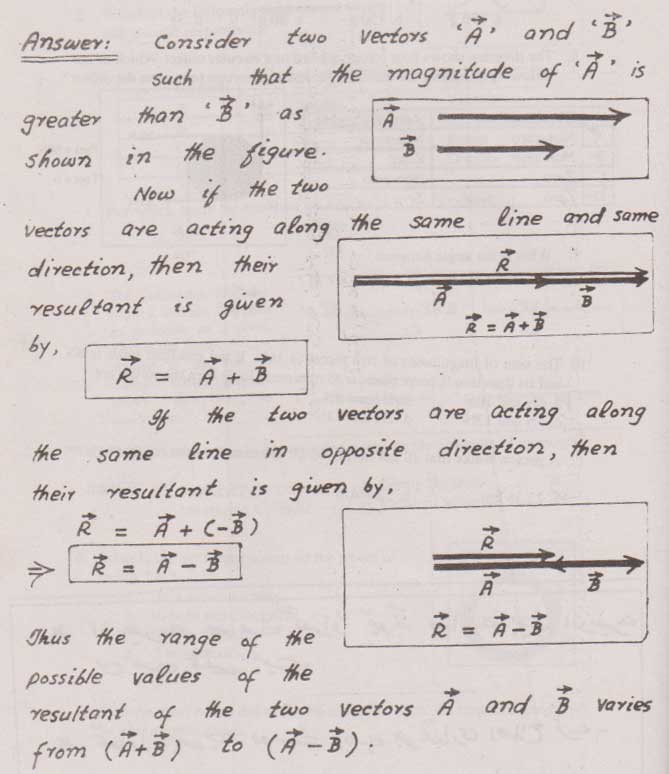
Question No. 50 - The vector sums of three vectors give a null vector. What can be orientation of the vectors?
Answer No. 50 - If the three vectors are oriented in cyclic order i.e in the form of triangle, then they will give rise to null vector.
Question No. 51 - Explain how cranes are able to light very heavy load without toppling?
Answer No. 51 - We know that object with a high centre of gravity are likely to be unstable . For this reason, the bases of the cranes are made low and heavy, so that centre of gravity remains low.
The torque produced by a heavy load lifted by a crane is counterbalanced by its heavy body and large moment arm. Thus the cranes do not topple when they carry heavy loads.
The torque produced by a heavy load lifted by a crane is counterbalanced by its heavy body and large moment arm. Thus the cranes do not topple when they carry heavy loads.
Previous Question
1-51
Next Question
Physics
11th Class Punjab Short Questions





11th Class Online Classes 2026
Updated on: 14-10-2026
11th Class Online Preparation
11th Class 2026 Online
11th Class 2026
Add a Comment
Comments will be shown after admin approval.
Spam comments will not be approved at all.
Matric Result 2026 Punjab
10th Class Result 2026 Punjab
9th Class Result 2026 Punjab Boards
10th Class Result Gazette 2026 Punjab
Punjab Past Papers Matric 9th 10th
Primary Results 5th & 8th Class
BISE Results Intermediate & Matric
BISE Punjab Boards
Sindh Educational Boards
KPK Examination Boards
Technical Boards
Public Service Commission
University Results Gruaduation, Masters Classes
Subscribe by Email
Subscribe by Email
Subscribe to Rss Feed


Position Holders Matric 2026
Position Holders 9th Class 2026
Position Holders Inter 2026
Position Holders 11th Class 2026