Chapter 3 Gases Chemistry 11th Class Punjab Short Questions
Question No. 1 - Why is the Boyle's law applicable only to the ideal gases?
Answer No. 1 - Boyle's law is applicable to those gases which have no forces of attractions among the molecules. Such gases are ideal. So, Boyle's law is applicable to only ideal gases.
Question No. 2 - How the value of the general gas constant 'R' can be derived with the help of Avogadro's law?
Answer No. 2 - 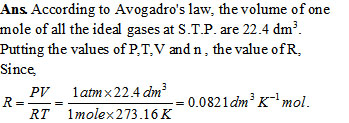
Question No. 3 - 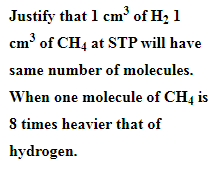
Answer No. 3 - 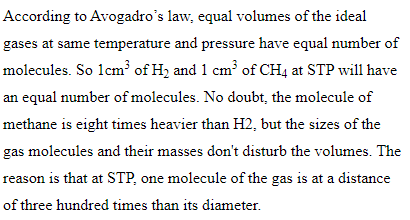
Question No. 4 - Why the gases deviate from ideal behavior at high pressure and low temperature?
Answer No. 4 - When the temperature of the gases are low, the attractive forces become dominant, so gases don't obey the gas laws. When the pressure of the gases are high, collisions become more frequent and force of attraction are created. Moreover, the actual volume of the gas molecules are no more negligible as compared to the volume of the vessel.
Question No. 5 - Gases deviate more from the general gas equation at 0° C and deviate to less extent at 100° C. why?
Answer No. 5 - At 0° C, the forces of attractions are dominant and gases become non-ideal. At high temperature attractive forces become less dominant and gases behave ideally.
Question No. 6 - Give two causes for deviation of gases from ideality?
Answer No. 6 - The causes are due to two faulty assume.
Actual volume of the gas molecules is negligible as compared to the volume of vessel.
There are no forces of attraction among the molecules of gases.
These two postulates are correct when the temperature is high or pressure is low.
Actual volume of the gas molecules is negligible as compared to the volume of vessel.
There are no forces of attraction among the molecules of gases.
These two postulates are correct when the temperature is high or pressure is low.
Question No. 7 - What are application of plasma?
Answer No. 7 - (i) Glowing plasma inside the bulb
(ii) Neon signs
(iii) Processing of semi-conductors
(iv) Sterilization of some medical products.
(v) Lamps
(vi) Lasers etc.
(ii) Neon signs
(iii) Processing of semi-conductors
(iv) Sterilization of some medical products.
(v) Lamps
(vi) Lasers etc.
Question No. 8 - Justify that the volume of given mass of a gas becomes theoretically zero at -273°C.
Answer No. 8 - 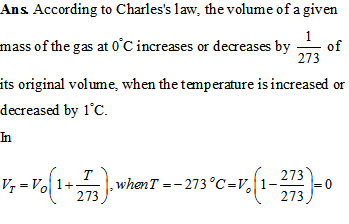
Question No. 9 - What are various scales of thermometry?
Answer No. 9 - 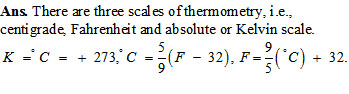
Question No. 10 - What is absolute zero? What happens to real gases while approaching it?
Answer No. 10 - It is the lowest possible temperature which would have been achieved if the substance remains in the gaseous state. All the real gases are converted to liquids above this temperature. This -273.16°C is called zero absolute or zero Kelvin.
Question No. 11 - How the density of an ideal gas doubles by doubling the pressure or decreasing the temperature on Kelvin scale by 1/2?
Answer No. 11 - 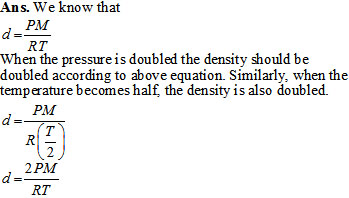
Question No. 12 - Why the non-polar gases like H2 and He have a very low critical temperatures while polar gases like NH3 and SO4 have critical temperatures, sufficiently above room temperature?
Answer No. 12 - H3 and He are consisted of small-sized molecules, and have low polar abilities. They have least forces of attractions among themselves. In order to liquefy them, their temperatures have to bring close to absolute-zero. NH3 and SO2 have attractive force event at room temperature. In order to liquefy them their temperature may be above the room temperature.
Question No. 13 - Why do we get a straight line when pressures are plotted against inverse of volumes? This straight line changes its positions in the graph by varying the temperature. Justify it.
Answer No. 13 - When the pressure of a gas is plotted against 1/V, we get a straight line at constant temperature. The reason is that P and 1/V are directly proportional to each other, with power unity on both variables. When the temperature
changes then value of p changes for same 1/V value.
changes then value of p changes for same 1/V value.
Question No. 14 - The amount of pressure which is decreased due to the forces of attraction is given by a/V2 where 'a' is the van der Waal's constant and V is the volume of the vessel.
Answer No. 14 - The pressure p is proportional to the number of molecules which are hitting on the walls of the vessel/area/sec. The number of molecules/area/sec. Is proportional to the density of the gas. P' (lessened pressure) depends upon the number of molecules which are attracting each other.
Question No. 15 - Charles's law is not obeyed when the temperature is measured on Celsius scale. Justify it.
Answer No. 15 - 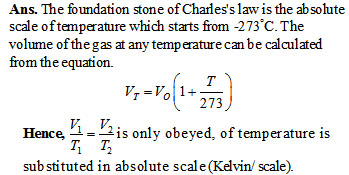
Question No. 16 - Lighter gases diffuse more rapidly than heavier gases. Give reason.
Answer No. 16 - At a given temperature the average. K.E. of different gas molecules are same. Since their masses are different, so their velocities will also be different. The lighter molecules will have greater velocities and so they WI diffuse rapidly.
Question No. 17 - How the behavior of real gases is given by van der waal's equation?
Answer No. 17 - The constant 'a' and 'b' called van der Waal's constants give the quantitative measurements of attractive forces and sizes of the gas molecules. These parameters are very important for the real gases.
Question No. 18 - In Joule-Thomson effect sudden expansion of the gas molecules needs energy. Why?
Answer No. 18 - In the compressed state, there are sufficient attractive forces among. The molecules of the gas. During sudden expansion, the energy is required to overcome the inter-molecular attractions. Moreover, the molecules need extra energy to run away in vacuum.
Question No. 19 - Dalton\'s law of partial pressures is only applicable to those mixtures of gases which are Ideal and they do not react with each other under the given conditions. Why?
Answer No. 19 - Dalton\'s low is applicable to the mixture of gases. All the gases in the mixture could have no forces of attractions or repulsion, so that they may be able to exert their own pressures independently. This is only possible when the gases are non-polar.
Question No. 20 - Calculate the S.I unit of R.
Answer No. 20 - 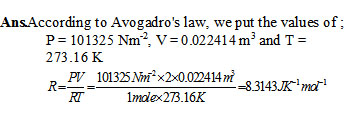
Question No. 21 - The product of pressure and volume at constant. Temperature and number of moles is a constant quantity. Why?
Answer No. 21 - 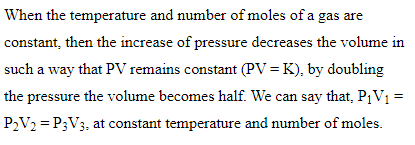
Question No. 22 - What are isotherms? What happens to the positions of isotherms when they are plotted at high temperature for a particular gas?
Answer No. 22 - Isotherms are the graphs between pressure and volume at constant temperature and number of moles. This condition is fulfilled by Boyle's law. The word isotherm means "same temperature".
Previous Question
1-22
Next Question
Chemistry
11th Class Punjab Short Questions










11th Class Online Classes 2026
Updated on: 14-10-2026
11th Class Online Preparation
11th Class 2026 Online
11th Class 2026
Add a Comment
Comments will be shown after admin approval.
Spam comments will not be approved at all.
Matric Result 2026 Punjab
10th Class Result 2026 Punjab
9th Class Result 2026 Punjab Boards
10th Class Result Gazette 2026 Punjab
Punjab Past Papers Matric 9th 10th
Primary Results 5th & 8th Class
BISE Results Intermediate & Matric
BISE Punjab Boards
Sindh Educational Boards
KPK Examination Boards
Technical Boards
Public Service Commission
University Results Gruaduation, Masters Classes
Subscribe by Email
Subscribe by Email
Subscribe to Rss Feed


Position Holders Matric 2026
Position Holders 9th Class 2026
Position Holders Inter 2026
Position Holders 11th Class 2026