Chapter 2 Experimental Techniques In Chemistry Chemistry 11th Class Punjab Short Questions
Question No. 1 - What is analytical chemistry?
Answer No. 1 - That branch of chemistry which deals with the quantitative and qualitative analysis is called analytical chemistry.
Question No. 2 - What is meant by mother liquor?
Answer No. 2 - The solution which remains behind after the formation of the crystals is called mother liquor.
Question No. 3 - What is the distribution coefficient? To which technique it is applicable.
Answer No. 3 - 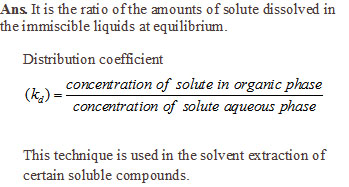
Question No. 4 - Define the term analysis.
Answer No. 4 - The process of determination of composition of a substance quantitatively or qualitatively is called analysis.
Question No. 5 - Give the main uses of paper chromatography.
Answer No. 5 - i. For the separation of purification of coloured organic compounds.
ii. For checking the purity of the compounds.
iii. In qualitative and quantitative analysis.
iv. For the separation, purification and identification of products of reactions.
ii. For checking the purity of the compounds.
iii. In qualitative and quantitative analysis.
iv. For the separation, purification and identification of products of reactions.
Question No. 6 - Define sublimation with an example?
Answer No. 6 - The vapourization of a solid directly on heating without passing through the liquid phase and the condensation of these vapours on cooling to solid without passing through liquid phase is called sublimation. Naphethalene, Iodive, NH4CI, Benzoic acid and Camphor undergo sublimation.
Question No. 7 - What is ether extraction?
Answer No. 7 - Some organic products are prepared in aqueous medium. We have to remove this organic compound from water. For this purpose, ether is added. Two separate layers are produced in the separating funnel. The ether layer contains the organic compound. This ether layer is separated and ether is evaporated.
Question No. 8 - What is called fluted filter paper?
Answer No. 8 - That filter paper which has a fan-like arrangement with alternate elevation and depressions at various folds, and is used to increase the rate of filtration is called fluted filter paper.
Question No. 9 - Mention various experiment techniques which are used for the purification of substances?
Answer No. 9 - The techniques are as follows:
(i) Filtration
(ii) Crystallization
(iii) Sublimation
(iv) Solvent extraction in depends upon the nature of the substances, that which technique is to be used.
(i) Filtration
(ii) Crystallization
(iii) Sublimation
(iv) Solvent extraction in depends upon the nature of the substances, that which technique is to be used.
Question No. 10 - Which solvents are mostly used in crystallization?
Answer No. 10 - The most commonly used solvents are:
(i) Water
(ii) Rectified spirit
(iii) Absolute alcohol
(iv) Ether
(v) Acetone
(vi) Chloroform
(vii) Carbon Tetra chloride
(viii) Acetic acid
(ix) Petroleum ether
(i) Water
(ii) Rectified spirit
(iii) Absolute alcohol
(iv) Ether
(v) Acetone
(vi) Chloroform
(vii) Carbon Tetra chloride
(viii) Acetic acid
(ix) Petroleum ether
Question No. 11 - Differentiate between stationary and mobile phase?
Answer No. 11 - The solvent or the mixture of solvents used for the separation components in chromatography is called mobile phase. The phase over which mobile phase flows is stationary one. Water, ethyl alcohol etc. are some important Mobile phases while silica gel and filter paper are some important stationary phases.
Question No. 12 - Mention the major steps involved in the crystallization.
Answer No. 12 - i. Preparing the saturated solution.
ii. Filtering the impurities.
iii. Cooling of the filtrate.
iv. Collection of crystals.
v. Drying of crystals.
Decolourinzation
ii. Filtering the impurities.
iii. Cooling of the filtrate.
iv. Collection of crystals.
v. Drying of crystals.
Decolourinzation
Question No. 13 - How the decolourization of undesirable colours is carried out for freshly prepared crystalline substances?
Answer No. 13 - The decolorization of undesirable colours is carried out by boiling the substance with sufficient amount of powdered animal charcoal in the solvent. Hot solution is filtered in this way charcoal absorbs the coloured impurities and the pure decolorized substance crystallizes on cooling.
Question No. 14 - Differentiate between filter and filtrate.
Answer No. 14 - Filter: Any water insoluble porous material which has a reasonable degree of rigidity and can be used to separate the components from each other is called filter.
Filtrate: That liquid which is collected after passing through the filter medium is called filtrate.
Filtrate: That liquid which is collected after passing through the filter medium is called filtrate.
Question No. 15 - Concentrated MCI and KMNO. Solutions cannot be filtered by Gooch crucible. Give reason.
Answer No. 15 - Conc. HCI and the oxidizing agents like KmnO, react with filter paper. By using Asbestos mate. The above solutions can be filtered.
Question No. 16 - How do you justify that qualitative and quantitative analysis are discussed in analytical chemistry?
Answer No. 16 - It is that branch of chemistry which gives up analysis of elements and compounds. In qualitative analysis, we come to know about nature of the elements and in quantitative analysis gives us the quantities of different elements in the compound.
Question No. 17 - How does a Gooch crucible increase the rate of filtration?
Answer No. 17 - This crucible is made up of porcelain. It has perforated base covered with a filter paper or asbestos mate. Filtration can be done quickly if this crucible is placed in a suction filtering apparatus.
Question No. 18 - Give the main characteristics of the solvent used for crystallization.
Answer No. 18 - i. The solvent should dissolve a large amount of solute at high temperature.
ii. The solvent should have no chemical reaction with solute.
iii. It should not dissolve the impurities.
iv. It should be cheap.
v. It should not be inflammable.
ii. The solvent should have no chemical reaction with solute.
iii. It should not dissolve the impurities.
iv. It should be cheap.
v. It should not be inflammable.
Question No. 19 - How desiccator is used to dry the crystals?
Answer No. 19 - The prepared crystals are wet and they need drying. In a desiccator, the crystals are spread on the watch glass and placed in a desiccator for several hours. Some drying agents like anhydrous CaCl2 silica gel or P205 are used.
Question No. 20 - What is Rf value?
Answer No. 20 - 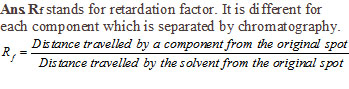
Question No. 21 - Differentiate between sublimand and sublimate.
Answer No. 21 - The solid substance which is being sublimed is called sublimand while the mire solid substance which is obtained after sublimation is called sublimate.
Question No. 22 - What is solvent extraction?
Answer No. 22 - This is a technique in which a solute is separated from the solution. For this purpose, the solution is shaken with another solvent in which the solute is more soluble. Anyhow, the added solvent should not be miscible with the solution.
Previous Question
1-22
Next Question
Chemistry
11th Class Punjab Short Questions




11th Class Online Classes 2026
Updated on: 14-10-2026
11th Class Online Preparation
11th Class 2026 Online
11th Class 2026
Add a Comment
Comments will be shown after admin approval.
Spam comments will not be approved at all.
Matric Result 2026 Punjab
10th Class Result 2026 Punjab
9th Class Result 2026 Punjab Boards
10th Class Result Gazette 2026 Punjab
Punjab Past Papers Matric 9th 10th
Primary Results 5th & 8th Class
BISE Results Intermediate & Matric
BISE Punjab Boards
Sindh Educational Boards
KPK Examination Boards
Technical Boards
Public Service Commission
University Results Gruaduation, Masters Classes
Subscribe by Email
Subscribe by Email
Subscribe to Rss Feed


Position Holders Matric 2026
Position Holders 9th Class 2026
Position Holders Inter 2026
Position Holders 11th Class 2026